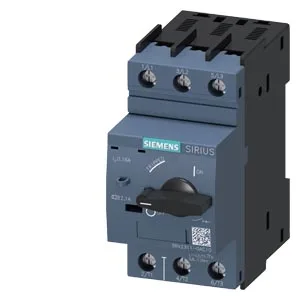
Breaking capacity is the headline number here: 100 kA at 400 V AC, and the same at 240 V, 500 V, and 690 V AC. That's a high-fault rating for a size S00 frame — it interrupts line-side faults up to 100 kA without needing an upstream fuse or larger breaker for coordination, which simplifies panel design and saves a DIN space.
Motor ratings and switching duty
At 230 V rated value the motor power rating is 0 kW — this variant is not intended for direct motor starting at that voltage. At 480 V and 600 V the rated current is 0.16 A, which points to a very small motor or control transformer primary protection. The AC-3 switching frequency is capped at 15 operations per hour, both at AC-3 and AC-3e maximum. That's a standard limitation for thermal-magnetic breakers in motor-starting duty — the bimetal needs time to reset between starts. Rated operational voltage range spans 20 to 690 V. AC-3 rated voltage maximum is 690 V.
Termination and environmental limits
Main current circuit terminations are screw-type terminals, accepting 2x (0.75 to 2.5 mm²) solid or stranded, or 2x 4 mm². Screwdriver shaft diameter 5 to 6 mm, Pozidriv size 2 tip. That's a standard M3 terminal for the main contacts — torque it to the manufacturer's spec and it holds for the life of the panel. Clearance distances: 50 mm upwards and downwards, 30 mm at the side, zero forwards and backwards. That last bit means you can butt it against the back panel or a neighbouring device without derating — useful when packing DIN rail tight.