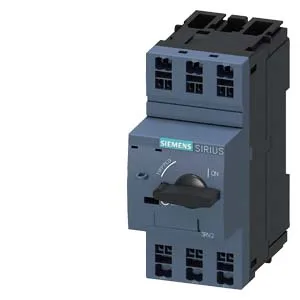
What the 100 kA SCCR means for your panel
At 690 V the interrupting rating drops to 10 kA — still adequate for most 690 V motor circuits, but worth noting if your service entrance feeds a high-fault 690 V bus.
Mounting and wiring — panel integration
The 45 mm width means it occupies one standard 45 mm module slot — three of these fit in a 135 mm wide section of rail. Depth is 97 mm, height 106 mm. Spring-loaded terminals on the main current circuit accept 2x 0.5 to 4 mm² solid or stranded conductors — no lug torqueing, just strip to 8 mm and push in.
Coordination with upstream protection
For selective coordination with a feeder breaker or fuse, the 3RV2311-1CC20 requires a gL/gG backup fuse sized at 25 A for 400 V and 500 V systems, and 20 A at 690 V. That fuse is not included — it's the upstream device that ensures the breaker's 100 kA SCCR is maintained. If you're replacing a 3RV2011-0BA20 in an existing panel, check the fuse sizing: the 3RV2011-0BA20 may have different backup requirements. The 3RV2311-1CC20's spring-loaded terminals also differ from the screw terminals on the 3RV2011-0BA20, so verify the conductor type and ferrule compatibility before swapping.