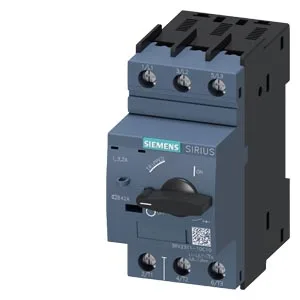
This breaker delivers 100 kA breaking capacity at 400 V and 500 V, and 10 kA at 690 V. For a motor starter combination, that 100 kA at 400 V means it can safely interrupt a fault current up to 100,000 A without upstream devices needing to clear the fault — critical for Type 2 coordination where the starter must remain operational after a short circuit. The rated voltage range spans 20 to 690 V, so it covers low-voltage control circuits through 690 V distribution.
Clearance requirements: 50 mm upwards and downwards, 30 mm to the side, 0 mm forwards and backwards — so you can butt it against the back panel and adjacent devices on the rail without derating. The screw-type terminals for the main current circuit accept 2x 0.75 to 2.5 mm² solid or stranded, or 2x 4 mm², with M3 screws. No ground fault or phase failure detection built in — that is handled separately in the starter assembly if required.
Fuse coordination and switching frequency
For backup fuse protection, the recommended gL/gG fuse ratings are 25 A at 400 V, 32 A at 500 V, and 25 A at 690 V. The maximum switching frequency under AC-3 (motor) duty is 15 operations per hour — adequate for most motor starting applications but not for high-cycle jogging or inching. The same 15 1/h limit applies under AC-3e duty.