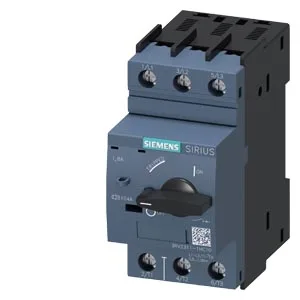
SIRIUS circuit breaker for starter combinations
Short-circuit ratings that define the installation
The 3RV2311-1HC10 carries a 100 kA short-circuit breaking capacity at both 240 V and 400 V, dropping to 42 kA at 500 V and 4 kA at 690 V. These SCCR figures determine whether this breaker can clear a fault without upstream devices needing to intervene — at 400 V, it handles the full 100 kA available fault current typical of industrial distribution, so it can be the sole protection device in the feeder. The gL/gG fuse coordination values (50 A at 400 V, 40 A at 500 V, 35 A at 690 V) tell you the maximum upstream fuse size that still allows the breaker to clear a fault within its rated capacity.
Motor load coverage
For motor applications, the breaker covers 5 hp at 460/480 V and 575/600 V, 2 hp at 200/208 V and 220/230 V, and 1 hp at 230 V. The AC-3e switching rate is 15 operations per hour maximum — this is a protection device, not a frequent-switching contactor, so it's sized for the motor branch circuit, not for cyclic duty.
At 45 mm wide and 97 mm deep, this breaker occupies a single 45 mm module on the DIN rail — standard for a motor-protective device in this class. Screw-type terminals on the main circuit accept 2x 0.75–2.5 mm² solid or stranded, or 2x 4 mm², using M3 screws. The 50 mm clearance required above and below, 30 mm to the side, and zero clearance forward and backward means it can be stacked tightly against adjacent devices as long as vertical airflow paths are respected.