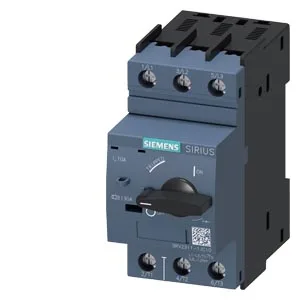
The Siemens 3RV2311-1JC10 is a SIRIUS-brand circuit breaker specifically designed for starter combinations — meaning it integrates motor protection and disconnection in one device, sized for a panel that combines a contactor and overload relay downstream.
Breaking capacity is the headline: 100 kA at 400 V AC and also at 240 V, then 42 kA at 500 V, and 4 kA at 690 V. Motor horsepower ratings are given per voltage: 1.5 hp at 230 V, 3 hp at 220/230 V, 5 hp at 460/480 V, and 10 hp at 575/600 V. These are the practical motor sizes this breaker protects in each voltage class — match your motor nameplate to these, not the raw current alone. Backup fuse ratings are specified: gL/gG 50 A at 400 V, 40 A at 500 V, and 40 A at 690 V. These are the maximum upstream fuse sizes that still allow the breaker to achieve its full breaking capacity — oversize the fuse and you lose the SCCR coordination. The rated voltage range spans 20 to 690 V, covering low-voltage control circuits through 690 V industrial mains. Maximum switching frequency under AC-3 duty (motor starting) is 15 operations per hour — fine for a pump or fan that cycles a few times an hour, but not for a rapid-reversing application like a servo axis.
Zero clearance front/back means it can sit flush against a panel door or backplate. Main circuit terminals are screw-type, accepting 2x 0.75 to 2.5 mm² solid or stranded, or 2x 4 mm². Screw size for main contacts is M3. No ground fault or phase failure detection built in — those functions live in the upstream protection or the overload relay.