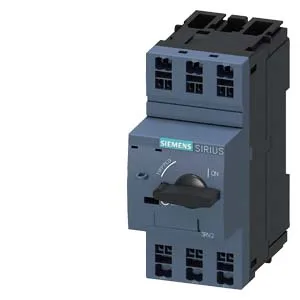
At 45 mm wide and 97 mm deep, it takes up a single modular slot, which matters when you're packing multiple motor starters into a tight enclosure. At 690 V it's rated 4 kA, so if you're running a 690 V line, the available fault current needs to stay under that limit.
For motor protection, the 3RV2311-1KC20 carries horsepower ratings across common North American voltages: 3 hp at 200/208 V, 8 hp at 460/480 V, and 10 hp at 575/600 V. That covers a lot of standard induction motors you'll find on pumps, fans, and conveyors. The maximum operating frequency in AC-3 duty (starting and stopping a running motor) is 15 operations per hour — fine for most process applications, but if you're cycling a motor every couple of minutes, you'll want to check the thermal duty cycle against your actual load. The gL/gG fuse coordination is specified per voltage: 63 A at 400 V, 50 A at 500 V, and 40 A at 690 V. That tells your panel builder what upstream fuse to select for selective coordination — so a fault on this branch doesn't take the whole panel down.
That zero forward clearance means you can butt it against a panel door or another device without heat buildup concerns — handy when you're stacking breakers in a row.