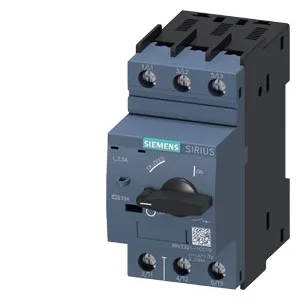
It's not a general-purpose feeder breaker; the design of the product is for starter combinations, so it's sized and coordinated for motor starting duty. Width is 45 mm; depth is 97 mm. The breaking capacity is the headline number here: 100 kA at 240 V AC, 400 V AC, and 500 V AC, dropping to 10 kA at 690 V AC. That 100 kA at 400 V is what lets this breaker sit on a high-fault panel bus without needing upstream current-limiting fuses — it's rated to interrupt a 100 kA fault directly. The 10 kA at 690 V still covers most industrial motor branch circuits at that voltage.
Motor sizing and coordination
The horsepower ratings tell you what motor this breaker protects: 0.5 hp at 200/208 V and 220/230 V, 1 hp at 460/480 V, and 1.5 hp at 575/600 V. For a 1 hp 460 V motor drawing roughly 1.4 A FLA, this breaker gives headroom; for a 2 hp motor, you'd step up. Rated insulation voltage: 20 to 690 V. Operating temperature: -20 to +60 °C.
Clearance distances are specified: 50 mm above and below, 30 mm to the side, 0 mm forward and backward. That 0 mm forward means the breaker can be mounted flush against the back panel or a busbar without extra spacing. The 50 mm vertical clearance is for arc venting and wiring bend radius — don't crowd it. Terminals are screw-type for the main current circuit, accepting 2x (1 to 2.5 mm²) or 2x (2.5 to 10 mm²) solid or stranded wire. M4 screw size on the main contacts. No ground fault or phase failure detection built in — that's handled by the upstream protection or a separate monitoring relay if needed.