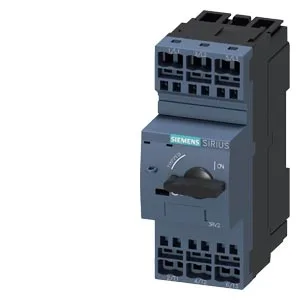
What this breaker does in a panel
The headline number here is the interrupting rating: 100 kA at 240 V, 400 V, and 500 V AC, dropping to 10 kA at 690 V AC. The 690 V rating at 10 kA still covers most industrial 690 V drives and distribution. No screw torque to verify, no loosening from vibration — a maintenance advantage on a line that sees frequent starts.
The breaker occupies 45 mm width, 119 mm height, 97 mm depth on the DIN rail. That 50 mm top clearance is the one that catches panel builders — skimping on it blocks heat dissipation from the bimetal trip and can cause nuisance tripping at rated current. The -20 °C floor matters for unheated enclosures in cold climates — the bimetal trip curve shifts below that, but the spec says it's rated down to -20.
What it does not do — and why that matters
This breaker has no ground-fault detection and no phase-failure detection. It is a thermal-magnetic motor circuit protector, not a full-featured electronic motor protection relay. If the application requires ground-fault or phase-loss tripping, you need an external relay (e.g., Siemens 3RB series) upstream or in series. For a standard pump or fan starter where the contactor already provides phase-loss protection via the control circuit, this omission is irrelevant. The switching frequency is capped at 15 operations per hour at AC-3 and AC-3e duty. That is fine for most motor starting (a pump cycling every 4 minutes), but not for jogging or rapid reversing. If the application calls for frequent inching, step up to a dedicated contactor with a higher mechanical life.