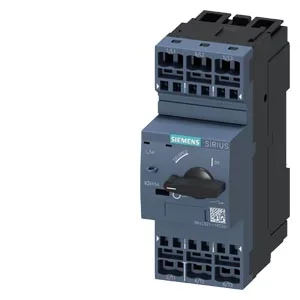
The Siemens 3RV2321-1FC20 is a SIRIUS-brand circuit breaker designed specifically for starter combinations — meaning it integrates with a contactor to form a coordinated motor starter pair, not a standalone feeder breaker. At 690 V the breaking capacity drops to 6 kA — a significant derate that governs where this breaker can be placed in a 690 V distribution. Clearance requirements are 50 mm upwards and downwards, 30 mm at the sides, zero forwards or backwards — that zero forward clearance means the breaker can sit flush against a panel door or backplane without derating.
Breaking capacity and motor ratings
The 3RV2321-1FC20 carries a 100 kA breaking capacity at 240 V, 400 V, and 500 V AC — that is the high-fault rating that makes it suitable for industrial panels with large upstream transformers. At 690 V it drops to 6 kA, and at 480 V and 600 V the continuous current rating is 5 A, not the breaking capacity. The motor horsepower ratings span from 0.17 hp at 110/120 V up to 3 hp at 460/480 V and 575/600 V. AC-3 switching duty is rated at 15 operations per hour maximum — that is the thermal limit for motor starting, not a continuous switching rate. For applications requiring frequent cycling, verify this matches the load profile.
Environmental and installation notes
The rated voltage span is 20 to 690 V. Mounting position is any. No ground fault detection and no phase failure detection are built in — those functions, if required, must come from an external relay or the upstream motor protection scheme.