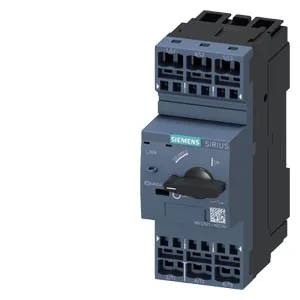
The 3RV2321-4EC20: The headline number for this class is the short-circuit breaking capacity. At 400 V AC, this breaker interrupts 55 kA. At 240 V AC it's rated 100 kA, at 500 V it drops to 5 kA, and at 690 V to 2 kA. The SCCR drops as voltage rises — that's normal for this class, but it means a 480 V panel with a 65 kA available fault current needs the 55 kA rating at 400 V, not the 2 kA at 690 V. Motor horsepower ratings are given across common voltages: 5 hp at 230 V, 10 hp at 220/230 V, 20 hp at 460/480 V. That tells you the maximum standard induction motor this breaker can protect at those line voltages. For a 480 V 20 hp pump motor, this breaker is sized right. If you're running a 25 hp compressor at the same voltage, you'd step up the frame. That's the maximum upstream fuse that still lets the breaker's own interrupting rating hold. If your panel feeds this breaker through a 100 A fuse, you lose the coordination and the SCCR drops to the fuse's rating — a common miss during panel build.
Mounting and wiring in the panel
The snap-on feature means no tools for the rail mount — useful when you're swapping this into an existing panel. Mounting position is any orientation, so vertical or horizontal rail is fine. Clearance requirements: 50 mm upward and downward, 30 mm to the side, 0 mm forward and backward. The zero forward/backward clearance means you can butt this against the back panel or a busbar cover without derating — a real space saver in a dense cabinet. Main circuit connection uses spring-loaded terminals — no screwdriver torque spec to chase, just strip and push. For a 20 hp motor at 480 V pulling about 27 A full load, 10 mm² is adequate. The spring clamp means faster terminations and no vibration loosening on a conveyor line. If you're replacing a different brand's 45 mm breaker, the footprint matches.
Environmental and operational limits
Rated operating voltage range is 20 to 690 V — covers everything from 24 V control circuits up to 690 V industrial mains. The -20 °C floor means it's fine in an unheated warehouse in most climates; below that you'd need a space heater in the panel. Maximum switching frequency in AC-3 duty is 15 operations per hour — that's typical for a manual motor starter, not a contactor cycling a weld gun every 10 seconds. No ground fault detection and no phase failure detection built in. That's expected for this class — it's a thermal-magnetic overload and short-circuit protector, not an electronic motor protection relay. If you need phase-loss or ground-fault protection, you add a separate relay or use a SIRIUS 3RB series electronic overload.