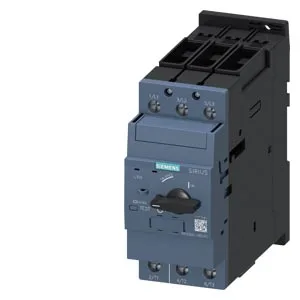
Rated at 32 A at both 480 V and 600 V, with a breaking capacity of 30 kA at 400 V, this part is built for industrial motor loads up to 25 hp at 460/480 V.
Dimensions are 149 mm deep, 55 mm wide, and 140 mm tall — a compact footprint that fits a standard 55 mm-wide DIN-rail slot. Clearance distances: 50 mm upward and downward, 10 mm to the side, zero forward and backward — so side-by-side packing is tight, but vertical spacing needs attention for arc-flash venting and wiring access. Terminals accept 2x (1 to 25 mm²) or 1x (1 to 35 mm²) solid or stranded copper, with M6 main-contact screws. That's a generous wire range for a 32 A device — allows paralleling smaller conductors or landing a single 35 mm² feed without adapters.
Ratings in context
Breaking capacity drops with voltage: 100 kA at 240 V, 30 kA at 400 V, 5 kA at 500 V, and 2 kA at 690 V. The 690 V figure (2 kA) is low — this breaker is not intended for 690 V distribution; it's a motor-circuit device. The rated insulation voltage spans 20 to 690 V, so the breaker itself is insulated for that range, but the interrupting rating governs the application. Maximum switching frequency at AC-3 (motor) duty is 15 operations per hour — that's typical for a thermal-magnetic breaker used for infrequent motor starting, not for rapid cycling. No ground-fault or phase-failure detection built in; those functions would need an external relay or a more advanced electronic trip unit.