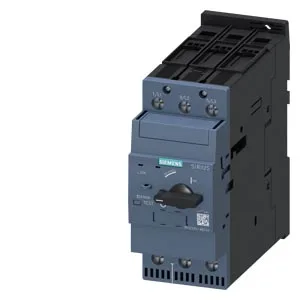
It's rated for a voltage range of 20 to 690 V, with a breaking capacity of 100 kA at 240 V and 50 kA at 400 V, so it can handle high-fault-current scenarios typical in industrial distribution panels.
Clearance and mounting realities
Mounting position is any, but clearance around the breaker depends on the voltage present. At 240 V, no clearance is required. At 400 V, you need 100 mm upwards and 50 mm downwards; at 500 V, 80 mm upwards; at 690 V, 63 mm upwards. Side clearance is 10 mm, and forwards/backwards clearance is 0 mm — it can sit flush against the back panel. This matters when packing multiple breakers into a row: the upward clearance at higher voltages eats into the usable DIN-rail height.
Ratings that drive the selection
The AC-3 and AC-3e switching frequency is capped at 15 operations per hour — that's the maximum for motor starting duty, not continuous current. The continuous current rating at 480 V is 20 A, and at 600 V also 20 A, so it's sized for smaller motor branch circuits. Horsepower ratings: 3 hp at 230 V, 7.5 hp at 200/208 V and 220/230 V, and 15 hp at 460/480 V. The 15 hp at 480 V is the headline figure for a typical US 480 V motor branch.