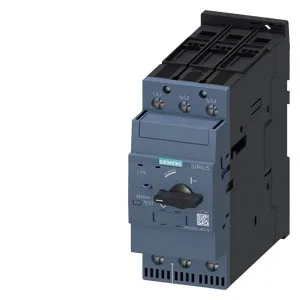
The Siemens 3RV2332-4TC10 is a SIRIUS-brand circuit breaker designed specifically for starter combinations — meaning it integrates motor branch-circuit protection and disconnecting means in one device, sized to coordinate with a contactor and overload relay in a motor starter assembly. Breaking capacity is rated 100 kA at 240 V, 50 kA at 400 V, 10 kA at 500 V, and 5 kA at 690 V — the 50 kA at 400 V is the figure most relevant for standard industrial three-phase distribution in IEC markets, telling you it can clear a fault up to that level without upstream fuses or a larger breaker.
Motor horsepower ratings are given per voltage: 3 hp at 230 V, 7.5 hp at 220/230 V, 15 hp at 460/480 V, and 17 A at both 480 V and 600 V — so for a 15 hp 480 V motor this breaker lands right on the nameplate current with no oversizing penalty. The screw-type terminals for the main current circuit accept 2x 1–35 mm² or 1x 1–50 mm² solid or stranded copper, with M6 bolts — that's substantial wire range for a 50 kA device, accommodating feeds from a 50 mm² supply cable down to a 1 mm² tap. No ground-fault or phase-failure detection built in — this is a straightforward magnetic-thermal motor circuit protector; those functions, if needed, must come from the attached overload relay or a separate module.
Dimensions are 55 mm wide, 140 mm high, 149 mm deep — the 55 mm width is a single modular unit on the DIN rail, leaving room for adjacent contactors and relays in a motor starter row. Clearance requirements: 50 mm upwards and downwards, 10 mm to the side, zero forwards and backwards — so you can butt it against the back panel and the enclosure door, saving depth in shallow cabinets.