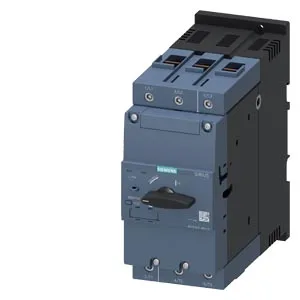
What this breaker does in a motor branch
The Siemens 3RV2342-4KC10 is a SIRIUS circuit breaker designed specifically for starter combinations — meaning it sits upstream of a contactor in a motor branch, providing short-circuit and overload protection in one package. It mounts on 35 mm standard DIN rail per DIN EN 60715, using either screws or the snap-on latch, and accepts any mounting position. That 50 kA breaking capacity at 400 V AC tells you it can interrupt a fault up to that level without the arc re-striking or the case rupturing — critical for coordinating with downstream contactors in a motor control center. At 240 V AC it's rated 100 kA, so in lower-voltage North American panels the fault-clearing headroom is even wider.
Motor horsepower coverage across common voltages
This breaker covers a broad motor horsepower range depending on line voltage: 7.5 hp at 110/120 V, 15 hp at 230 V, 30 hp at 220/230 V, 60 hp at 460/480 V, and 75 hp at 575/600 V. That 75 A continuous rating at 600 V lines up with the 75 hp motor curve at that voltage. For a 400 V industrial line it's 50 kA SCCR, and at 690 V it still holds 3 kA — enough for most European motor branches where the transformer impedance limits fault current.
Integration into the panel
Physical fit: 176 mm deep, 70 mm wide, 165 mm tall. Clearance requirements are modest — 150 mm above and below, 30 mm to the side, zero forward or backward. The screw-type terminals accept 2x (2.5 to 16 mm²) solid or stranded on the main circuit, and up to 2x (2.5 to 50 mm²) or 1x (10 to 70 mm²) on the line/load side. No ground-fault or phase-failure detection built in — that's handled by the upstream supply or a separate module. Operating temperature range is -20 to +60 °C; storage and transport tolerate -50 to +80 °C.
