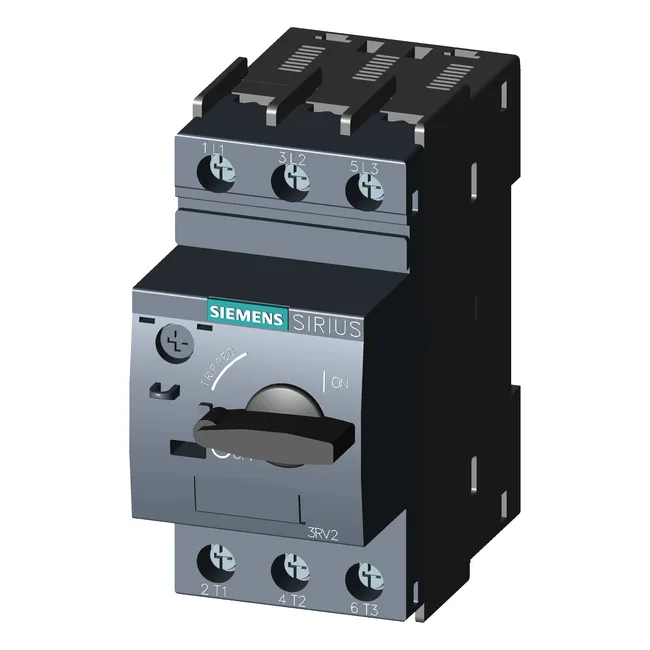
Rated operating voltage spans 20 to 690 V, with a symmetrical breaking capacity of 100 kA at 240 V, 400 V, 500 V, and 690 V AC — meaning it clears faults up to that level without cascading upstream, a critical spec for transformer primary-side protection where available fault current can be high. Trip Class 10 ensures the breaker trips within 10 seconds at 7.2× rated current, matching the inrush profile of typical transformers (which can draw 8–12× rated for a few cycles) without nuisance tripping, while still protecting against sustained overloads.
Ground fault detection is not included, so for systems requiring GF protection, an external device must be added. Storage and transport range extends to -50 to +80 °C. Screw-type terminals for the main current circuit accept solid or stranded conductors: 2× (0.75 to 2.5 mm²) or 2× 4 mm². Terminal screws use M3 thread, requiring a screwdriver shaft diameter of 5 to 6 mm — standard for panel wiring. Dimensions of 97 mm depth, 45 mm width, and 97 mm height, with required clearances of 50 mm upward and downward, 30 mm to the side, and zero forward/backward clearance — this fits tightly against the panel backplane, saving enclosure depth.