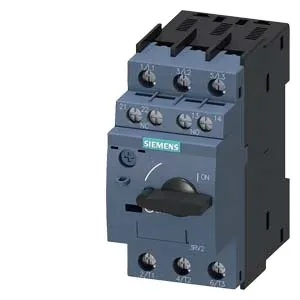
The Siemens SIRIUS 3RV2411-0FA15 is a circuit breaker specifically designed for transformer protection, part of the SIRIUS product family. It provides overcurrent and short-circuit protection for transformers in control panels and industrial installations, with phase failure detection built in. Its key rating is the breaking capacity: 100 kA at 400 V, 500 V, and 690 V, and also 100 kA at 240 V. That's the standard thermal-magnetic curve for motor and transformer starting duty — fast enough to protect the winding but slow enough to ride through inrush.
Width is 45 mm. Clearance requirements: 50 mm upwards and downwards, 30 mm at the sides. That's the free air space needed for arc quenching and heat dissipation. In a crowded cabinet, those numbers matter for the gland plate and busbar planning. Main contacts use M3 screw-type terminals, accepting 2x (0.5 to 1.5 mm²) or 2x (0.75 to 2.5 mm²) solid or stranded wire. That covers the typical transformer secondary and primary wiring sizes up to about 2.5 mm².
Why this rating matters in the field
Rated operating voltage range is 20 to 690 V, covering low-voltage control circuits up to 690 V industrial mains. The auxiliary contact ratings: 1 A at 24 V, 0.5 A at 120 V, 0.5 A at 230 V, and 0.15 A at 60 V. For the main circuit at 690 V, the fuse rating is gL/gG 4 A. Maximum switching frequency in AC-3 and AC-3e duty is 15 operations per hour. That's typical for a transformer protection breaker — not meant for frequent switching like a contactor, but for occasional isolation and fault protection.