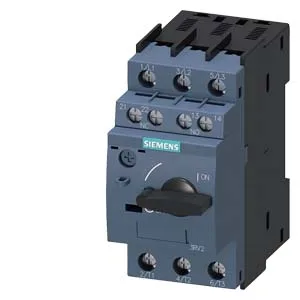
The Siemens SIRIUS 3RV2411-0HA15 is a circuit breaker specifically designed for transformer protection. It's part of the SIRIUS product brand, and it's built to handle the inrush and overload characteristics of a transformer primary, not just a motor. That's the main distinction here — the trip curve and the ratings are tuned for that magnetizing inrush, so you don't get nuisance trips on energization. It carries a breaking capacity of 100 kA at 400 V, 500 V, and 690 V, and also at 240 V. For a transformer-fed circuit, that headroom matters because the available fault current can be high. That's standard for motor protection, but here it's applied to the transformer's overload profile. Phase failure detection is included — if one phase drops out, the breaker sees the unbalance and trips, which prevents single-phasing damage on a three-phase transformer.
Mounting and wiring — panel fit
Mounting position is any, which gives you flexibility in a crowded panel — you can lay it sideways if the gland plate dictates. That 45 mm width is a single modular unit, so it takes up one slot on the rail. The depth of 97 mm means you need that clearance behind the rail for the body and the terminals. Terminals for the main current circuit are screw-type, accepting solid or stranded wire: 2x (0.5 to 1.5 mm²) or 2x (0.75 to 2.5 mm²). That's a standard range for control panel wiring — you can double up a 1.5 mm² and a 2.5 mm² feed. The main contact terminals are M3, so have a #6 or M3 ring tongue ready. Clearance distances are specified: 50 mm upwards and downwards, 30 mm at the side. That's the free air space you need around the breaker for arc quenching and heat dissipation. Forwards and backwards clearance is 0 mm — meaning it can sit flush against the back panel or a cover, which is handy in a shallow enclosure.
Environmental and operational limits
During operation, it's rated for -20 to +60 °C. That's a wide thermal envelope — it can sit in a hot warehouse or a freezing truck without damage. The operating range is what governs in the panel; if your enclosure gets above 60 °C, you'll need to derate or ventilate. The rated voltage span is 20 to 690 V, covering most low-voltage systems from control circuits up to 690 V industrial mains. Switching frequency is max 15 operations per hour at AC-3 and AC-3e duty — that's not a fast-cycling breaker; it's meant for occasional switching, not a high-speed process.