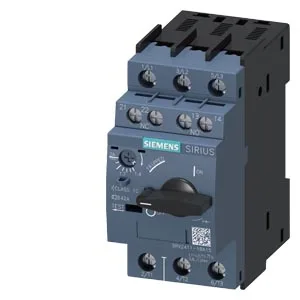
It carries 100 kA breaking capacity at 400 V and 500 V, and 10 kA at 690 V — so on a 400 V secondary side of a transformer, this breaker clears faults up to 100 kA without needing upstream fuses to cascade.
The CLASS 10 trip class means the bimetal releases in 10 seconds or less at 7.2× the thermal setting — standard for transformer inrush, which can hit 8–12× rated for a few cycles. A CLASS 10 holds through that inrush without nuisance tripping while still protecting against sustained overloads. The maximum switching rate is 15 operations per hour in AC-3 duty, which is fine for transformer tap changing or infrequent load switching but not for a high-cycle motor start application. For SCCR coordination, the fuse backup ratings are given: gL/gG 25 A at 400 V and 500 V, gL/gG 20 A at 690 V. If the available fault current exceeds 100 kA at 400 V, or 10 kA at 690 V, upstream fuses at those ratings are required to keep the breaker within its interrupting rating. The 690 V rating drops to 10 kA, so on a 690 V system the available fault current must be verified against that lower limit.
Mounting position is any, so horizontal or vertical panel layouts are fine. That 50 mm vertical clearance is for arc venting — don't crowd the vents against a panel wall or cable duct. Terminals for main contacts are M3 screws, accepting 2× 0.5–1.5 mm² or 2× 0.75–2.5 mm² solid/stranded.