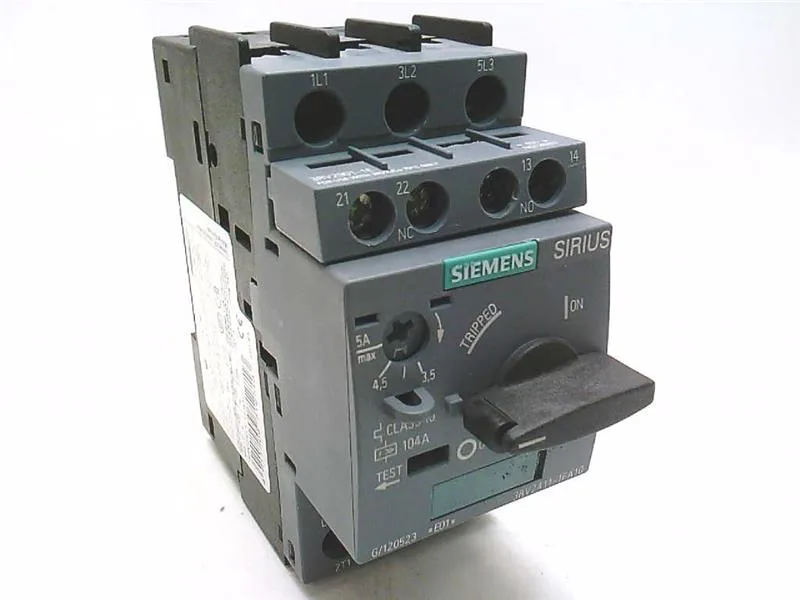
Transformer-protection breaker, Class 10 trip
Rated breaking capacity hits 100 kA at 400 V and 500 V, dropping to 4 kA at 690 V — the 100 kA figure covers the most common industrial distribution voltages, so this breaker can sit downstream of a large transformer without worrying about fault current exceeding its interrupt rating.
Clearance requirements: 50 mm above and below, 30 mm to the side, zero forward or backward. That 50 mm vertical gap is needed for arc-gas venting and thermal dissipation — don't crowd it against a gland plate or another device. Screw-type terminals on the main circuit accept up to 2× 4 mm² solid or stranded, or 2× 2.5 mm² with ferrules. The M3 contact screws are standard for this class; torque them to the spec on the nameplate, not by feel.
Back-up fuse coordination
When installed behind a transformer, the manufacturer specifies maximum back-up fuse ratings: 32 A gL/gG at 400 V and 500 V, dropping to 25 A at 690 V. These are the fuses that protect the breaker itself under a high-fault condition — the breaker clears the fault, the fuse only operates if the fault exceeds the breaker's interrupt rating.