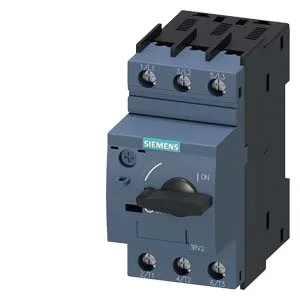
Transformer protection circuit breaker — what the ratings mean for your panel
The Siemens SIRIUS 3RV2411-1JA10-0BA0 is a Size S00 circuit breaker purpose-designed for transformer protection, with a Trip Class 10 thermal overload characteristic that matches the inrush profile of small-to-medium transformers — it allows the magnetizing inrush without nuisance tripping while still protecting the winding against sustained overload. The interrupting ratings tell you where this breaker can safely clear a fault: 100 kA at 230 V and 400 V AC, 42 kA at 500 V AC, and 4 kA at 690 V AC. That 100 kA at 400 V means it handles high-fault-current panels without needing upstream current-limiting fuses — a real advantage in transformer secondary circuits where available fault current can run high. It mounts on a 35 mm DIN rail per DIN EN 60715, using either the screw-fastening or snap-on method. The 45 mm width (three TE) and 97 mm depth fit standard panel layouts; the any-position mounting gives flexibility in crowded enclosures. Phase failure detection is built in, so a lost phase on the transformer primary or secondary will trip the breaker — no separate phase-loss relay needed. Ground fault detection is not included, so if that's required, plan for an external GF module.
Integration notes — wiring and clearances
Screw-type terminals on the main current circuit accept 2x (0.75 to 2.5 mm²) solid or stranded, or 2x 4 mm². The screwdriver shaft should be 5 to 6 mm diameter, Pozidriv size 2 tip. Clearance requirements: 50 mm upwards and downwards, 30 mm at the sides, zero forwards and backwards — so it can sit flush against the back panel. Ambient operating range is -50 to +60 °C, with storage and transport range -50 to +80 °C. The gG fuse backup ratings at 400 V (50 A), 500 V (40 A), and 690 V (40 A) should be matched when coordinating with upstream protection.
