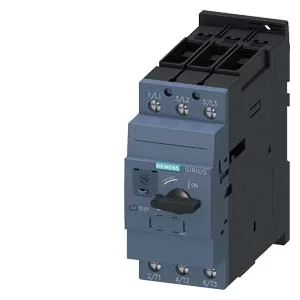
That distinction matters: the trip curve and thermal memory are tuned for the inrush and magnetizing current profile of a transformer primary, so it won't nuisance-trip on energization while still clearing a winding fault.
This breaker carries a 100 kA interrupting rating at 240 V AC, 65 kA at 400 V AC, 6 kA at 500 V AC, and 3 kA at 690 V AC. The 65 kA at 400 V is the figure that governs most European industrial panels fed from a 400 V distribution transformer — it means the breaker can safely interrupt a bolted fault up to 65,000 A without welding contacts or venting arc gas into the enclosure.
The 55 mm width occupies three standard 18 mm modular spaces, and the 149 mm depth means it projects about 15 mm deeper than a typical IEC motor starter — check your enclosure depth if retrofitting into a shallow gland plate. Any mounting position is permitted, so vertical or horizontal busbar orientation won't derate the thermal trip. Clearance: 50 mm above and below, 10 mm to the sides, zero forward or backward — the breaker can be stacked tight against the back panel or enclosure door.
Main current circuit terminals are screw-type, accepting 2× (1–25 mm²) or 1× (1–35 mm²) solid or stranded copper. The main contact screws are M6 — torque them to the manufacturer's specification (typically 4–5 Nm for M6 on this class) to avoid thermal rise under continuous transformer load. The operating voltage range is 20–690 V, covering control voltages from 24 V to 690 V line.