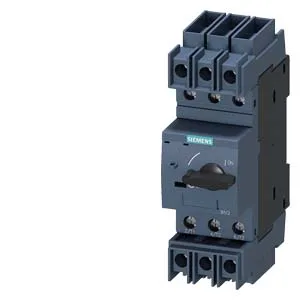
Transformer protection circuit breaker, 100 kA across the voltage band
The Siemens 3RV2811-1AD10 is a SIRIUS circuit breaker designed specifically for transformer protection, conforming to UL 489 and CSA C22.2 No.5. Its headline figure is a 100 kA breaking capacity maintained from 240 V through 690 V AC — meaning it can safely interrupt fault currents up to 100,000 amps at any of those voltage levels without upstream fuses needing to clear first. That flat SCCR curve simplifies coordination in a panel where multiple voltage taps exist. The breaker occupies the Size S00 frame — 45 mm wide, 97 mm deep, 144 mm tall — and mounts via screw or snap-on onto 35 mm standard mounting rail per DIN EN 60715. Any mounting position is permitted, which gives panel layout flexibility when the transformer sits in a tight enclosure corner.
Lifecycle and compliance posture
Terminals accept 1 to 10 mm² solid or stranded (max 2×10 mm²) with M4 main-contact screws. The screwdriver shaft diameter is 5 to 6 mm, Pozidriv size 2 tip — a standard electrician's tool, no special bits required.
Selectivity and backup protection
When the prospective fault current exceeds the breaker's own interrupting rating — unlikely given the 100 kA ceiling, but relevant on very high-capacity transformers — the backup fuse ratings are specified: gL/gG 20 A at 500 V, gL/gG 16 A at 690 V. This lets the designer size upstream fuses that coordinate with the breaker's let-through energy rather than over-fusing and losing selectivity on secondary-side faults. The breaker does not include ground-fault or phase-failure detection. Those functions, if required, must be added externally via a monitoring relay or an electronic trip unit upstream. For a transformer primary, this is typical — the protection focus is on short-circuit and overload, not phase imbalance.
Panel integration and clearances
Minimum clearances: 70 mm upwards and downwards, 30 mm to the side, zero forwards and backwards. The 45 mm width per pole matches the S00 footprint.