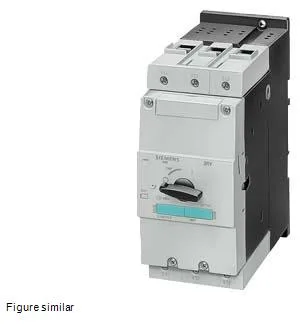
The thermal overload release (CLASS 10) handles the motor's heating curve, while the magnetic short-circuit trip clears faults fast enough to protect the contactor and cable. Rated 75 A at AC-3 400 V, it can handle a 37–45 kW motor depending on the exact duty cycle and ambient conditions. The 75 A rating at AC-3 (400 V) is the key selection figure — this is the motor-switching current under normal starting and running conditions. The S3 frame (174 mm deep × 70 mm wide × 165 mm high) leaves 0 mm backwards clearance, so it sits flush against the backplane; plan for 50 mm upwards, 50 mm downwards, 30 mm at the sides, and 167 mm forwards for wiring access and arc-chute clearance.
Screw-type box terminals accept solid or stranded conductors: 2× (2.5…16 mm²), 2× (10…50 mm²), or 1× (10…70 mm²). For AWG, that translates to 2× (10…1/0) or 1× (10…2/0). Terminal torque is 4–6 N·m. The connectors are arranged top and bottom, which keeps the wiring straight and simplifies busbar runs in a multi-breaker panel. Mounting position is any — vertical, horizontal, or tilted — so it fits tight enclosures. Operating temperature range is -20…+60 °C; transport range is -50…+80 °C. Relative humidity up to 95 % during operation is fine for non-condensing environments. Installation altitude is limited to 2000 m above sea level without derating. Shock resistance is 25 g / 11 ms per IEC 60068-2-27, and surge voltage resistance is 6 kV — both figures confirm it can live on a machine-side panel subject to contactor bounce and switching transients.