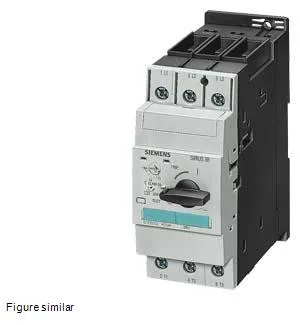
It carries a 20 A rated operational current (AC-3 at 400 V) and a Class 10 trip characteristic, meaning the thermal overload release responds fast enough to protect a transformer winding against sustained overcurrent without nuisance tripping on inrush. The S2 frame size keeps the footprint compact at 55 mm wide, 140 mm tall, 149 mm deep — it fits a standard 55 mm slot in a DIN-rail panel without crowding adjacent devices.
The 20 A rating at AC-3 (690 V maximum) tells you this breaker switches motor-like loads — inductive, with moderate inrush — up to that current. For transformer protection, the magnetic short-circuit trip clears faults quickly, while the thermal overload release is tuned to the thermal time constant of a transformer, not a motor. The 12 W typical power loss is modest enough that ventilation in a sealed panel is rarely an issue. That's faster than Class 20 or 30, which matters when protecting a transformer that can't tolerate sustained overload the way a motor can. If you're used to motor-protective breakers with Class 10 or 20, this one is on the faster end of that range.
Screw-type box terminals on the main current circuit accept 2×(0.75…25 mm²) solid/stranded or 1×(0.75…35 mm²). For AWG, that's 2×(18…2) or 1×(18…2). Tightening torque is 3…4.5 N·m — a standard screwdriver handles it. The terminals are arranged top and bottom, which keeps the wiring straight in a typical panel layout. Clearance requirements: 50 mm upward, 140 mm forward, 0 mm backward (flush to the rail), 50 mm downward, and 30 mm at the side. That backward clearance of zero means you can mount it tight against a backplane or enclosure wall without derating.
Operating temperature range is -20…+60 °C; storage/transport range is -50…+80 °C. Relative humidity during operation can be 10…95 %. It's rated for installation altitudes up to 2 000 m above sea level. Shock resistance per IEC 60068-2-27 is 25 g / 11 ms. The part is RoHS-compliant with a substance prohibition date of 07/01/2006.