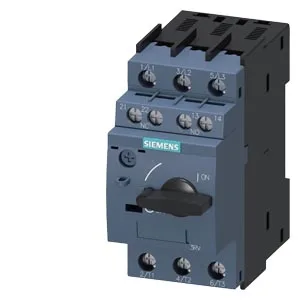
It combines a thermal overload relay (Class 10 trip) and a magnetic short-circuit release in one package, so it protects the motor and the feeder from overload and fault currents without needing a separate overload relay. Rated 5 A at AC-3 and 690 V maximum. The 6 W typical power loss is low enough for tight DIN-rail packing. The 45 mm width and 96 mm depth leave room for a contactor alongside.
IEC ratings (690 V, 6 kV surge voltage, 25g shock) support CE marking.
The magnetic short-circuit release is fixed (non-adjustable) and set to trip instantaneously on high fault currents — typical for a motor-protective device that must clear a bolted fault before the contactor or upstream breaker sees damage. The 6 kV rated surge voltage resistance (impulse withstand) tells you the insulation coordination is adequate for 400 V systems with standard overvoltage category III. The 10 to 95 % relative humidity rating (non-condensing) is typical for IP20 finger-safe terminals — not for washdown areas.
Screw-type terminals on both the main circuit and the auxiliary/control circuit. The main terminals accept 2× (0.5 to 1.5 mm²) solid/stranded or 2× (0.75 to 2.5 mm²) — that is two wires per pole, which is handy for daisy-chaining the supply to a contactor coil. AWG equivalents are 2× (18 to 12) for the mains and 2× (20 to 16) for the aux contacts. Tightening torque is 0.8 to 1.2 N·m — a standard small screwdriver, no torque wrench needed. The auxiliary switch is transverse design, keeping overall depth at 96 mm.