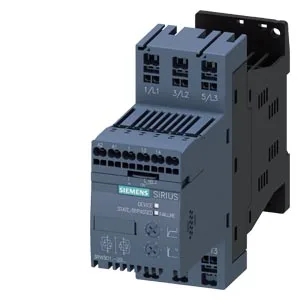
Soft starter for standard motor starting
The 3RW3014-2BB14: It uses thyristor-based voltage ramp control to limit inrush current during start-up, reducing mechanical stress on the driven load and electrical stress on the supply. The integrated bypass contact system means the thyristors are shorted out once the motor reaches full speed, eliminating continuous power dissipation in the semiconductors and keeping the panel temperature rise in check. This matters for the 45 mm wide DIN-rail footprint — no extra bypass contactor to wire or cool.
Current derating and thermal limits
The derating temperature is 40 °C — above that, the output current must be reduced linearly. For a motor drawing 5.5 A FLA in a 50 °C enclosure, this starter still has headroom; at 60 °C ambient it runs at the derated limit. The pollution degree is 3 per IEC 60947-4-2, meaning the device is designed for conductive pollution environments typical of industrial control panels — no conformal coating required for normal factory atmospheres.
Mounting, wiring, and panel integration
Mounting is screw and snap-on DIN rail — the 45 mm width and 120 mm height fit standard S00-size slots. The 150 mm depth is the body depth; allow 60 mm upwards and 40 mm downwards clearance for airflow and wiring access, plus 15 mm at the sides. Mounting position allows ±10° rotation and ±10° tilt forward/back from vertical — useful when the panel layout forces a slight angle. Main circuit terminals are spring-loaded, accepting 16-12 AWG solid. Auxiliary and control circuits also use spring-loaded terminals, accepting 24-14 AWG and 2x (0.25-2.5 mm²) solid. Maximum motor wire length is 300 m — beyond that, reflected wave overvoltage from the thyristor switching can stress motor insulation. For long cable runs, consider an output reactor or dV/dt filter between the starter and the motor.
Control supply and protection features
Control supply voltage is 110-230 V DC, a wide-range input that simplifies panel wiring — one supply rail covers both 110 V and 230 V DC systems without a jumper change. Operating frequency is 50-60 Hz, covering standard mains worldwide. This starter has no motor overload protection, no intrinsic device protection, and no adjustable current limitation. External overload relay or motor protection breaker is required in the circuit. The minimum load is 10% — running below that may cause the thyristors to not commutate properly. Fault signal is a red display. No external reset input — fault reset is via the control supply cycle or a remote signal on the control terminals. No inside-delta circuit configuration means this is a standard in-line soft starter, not a six-wire delta-connected version.