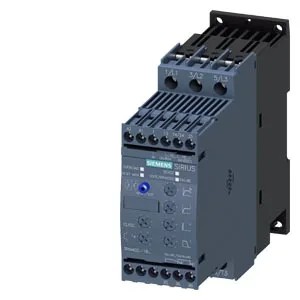
32 A at 40 °C — derating drives the real current limit
The 3RW4027-1BB05: That 40 °C baseline is the typical unventilated panel ceiling — if your enclosure runs hotter, the usable current drops by about 10 % per 10 °C rise. The integrated bypass contact system shunts the thyristors out of the circuit once the motor reaches full speed, eliminating the heat load from the semiconductor junction during steady-state running. That means the derating curve applies only during the start cycle — continuous current after bypass is limited by the bypass contacts, not the thyristors.
Size S0 frame — panel layout and mounting constraints
The unit measures 45 mm wide by 125 mm high by 155 mm deep, fitting the S0 frame footprint common across the SIRIUS 3RW40 series. Fastening is screw and snap-on mounting — the DIN rail clip holds it in place, but the screw lug provides positive retention under vibration. Mounting position matters for the internal fan: with the additional fan fitted, the unit allows vertical mounting surface rotation of ±90° and tilt of ±22.5° front/back. Without the fan, rotation is limited to ±10° and tilt to ±10° — plan the panel layout so the soft starter sits within those limits or add the fan. Clearance requirements: 60 mm upwards, 40 mm downwards, 15 mm at the sides. These are the minimum air gaps for natural convection cooling — stacking units closer than that forces additional derating or forced airflow.
Motor protection and control features built in
Motor overload protection, intrinsic device protection, and adjustable current limitation are all integrated — no separate overload relay needed downstream. The minimum load is 20 %, so it handles lightly loaded motors without nuisance tripping. External reset allows the soft starter to be reset from a remote pushbutton or PLC output after a fault trip. The red fault signal display gives local indication of the trip cause. Maximum wire length to the motor is 300 m — for longer cable runs, reflected wave overvoltage at the motor terminals becomes a risk, especially on 600 V insulation systems. Keep the run under that limit or add an output reactor.