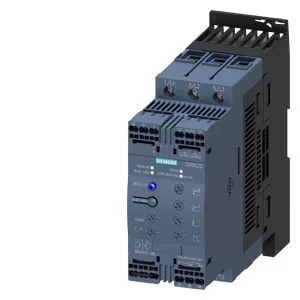
The 3RW4037-2BB14: The bypass contact system means the thyristors only handle the start transient — during continuous run, current passes through the bypass contacts, dropping the heat load inside the enclosure and letting you size the panel ventilation for the start duty, not the full-run dissipation.
Temperature derating and enclosure planning
Rated current steps down with ambient: 63 A at 40 °C, 58 A at 50 °C, 53 A at 60 °C (-). If the panel ambient hits 50 °C, you lose 5 A of continuous motor capacity — plan the thermal budget before you lock the gland plate. The S2 frame measures 55 mm wide by 160 mm high by 170 mm deep. Snap-on DIN rail mounting with an additional screw fastening point keeps it secure under vibration in a mobile or conveyor-side panel. Clearance requirements: 60 mm above, 40 mm below, 30 mm at the sides. Stack multiple units side by side at the 30 mm gap and the derating curve shifts — allow the full free-air spacing if you want the 63 A figure at 40 °C.
Control supply and wiring terminals
Control supply accepts 110 to 230 V DC — common for 125 V DC control buses in industrial plants or 220 V DC battery-backed systems. The wide input range means it works across sites without a separate DC-DC converter. Maximum motor cable length is 300 m — beyond that, reflected wave voltage spikes at the motor terminals can stress the winding insulation, especially on 480 V and 600 V systems.
Pollution degree 3 and operating range
This is the standard for control panels in manufacturing environments not sealed to IP54. Operating ambient -25 to +60 °C, storage -40 to +80 °C. The thyristor junction temperature tracks the ambient plus the I²t of the start pulse — at 60 °C ambient you are at the derated 53 A ceiling, so a heavy start (long acceleration, high inertia load) may need a larger frame. Insulation voltage rated 600 V — suitable for 400 V and 480 V systems. Operating frequency 50/60 Hz.