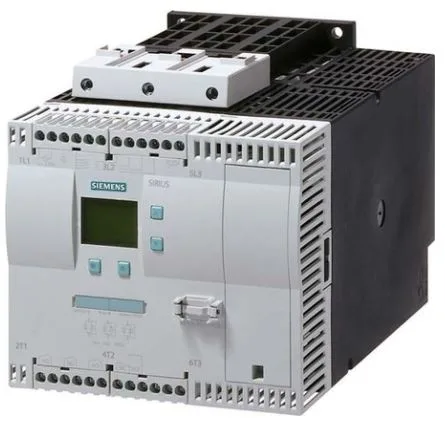
The Siemens 3RW4424-1BC44 is a SIRIUS 3RW44 soft starter for three-phase induction motors, built around thyristor stacks with an integrated bypass contact system that removes the semiconductors from the circuit once the motor reaches full speed — cutting heat dissipation in the enclosure and extending the life of the power stage. Rated 81 A at 40 °C, it derates to 73 A at 50 °C and 64 A at 60 °C, so the ambient temperature inside the panel directly governs the motor current it can handle — a 40 °C panel buys you the full nameplate; a 50 °C panel loses about 10 % of the rating. Insulation voltage is rated 690 V, operating frequency 50 … 60 Hz at 230 V, and the unit supports inside-delta circuit wiring — a configuration that lets a smaller-rated soft starter control a larger motor by placing the thyristors in the delta legs rather than the line. Motor overload protection is built in, adjustable current limitation is standard, and the minimum load is 8 % of the rated current — meaning it can handle very lightly loaded motors or unloaded starts without dropping out.
Fastened by screw fixing to a vertical mounting surface; the unit can be rotated ±90° or tilted ±22.5° front-to-back, giving flexibility in tight enclosures. Dimensions are 170 mm wide, 192 mm high, 270 mm deep — a substantial footprint that needs 100 mm clearance above, 75 mm below, and 5 mm at the sides for airflow and wiring access. Main current circuit uses box terminals accepting stranded 2x (4 … 50 mm²) or solid 2x (0.5 … 2.5 mm²); auxiliary and control circuits use screw-type terminals for 2x (20 … 14 AWG). Maximum motor cable length is 500 m — relevant when the starter is panel-mounted far from the motor, as long cable runs increase charging current that can nuisance-trip the overload.
Environmental and protection features
Operating temperature range is 60 °C maximum during operation; storage range is -25 … +80 °C. Intrinsic device protection (over-temperature monitoring of the thyristors) is included, and an external reset input allows remote fault clearing — useful for unattended or remote installations. Fault signals are shown on an integrated display, not just a single LED — giving a plain-text or coded fault message that speeds troubleshooting.