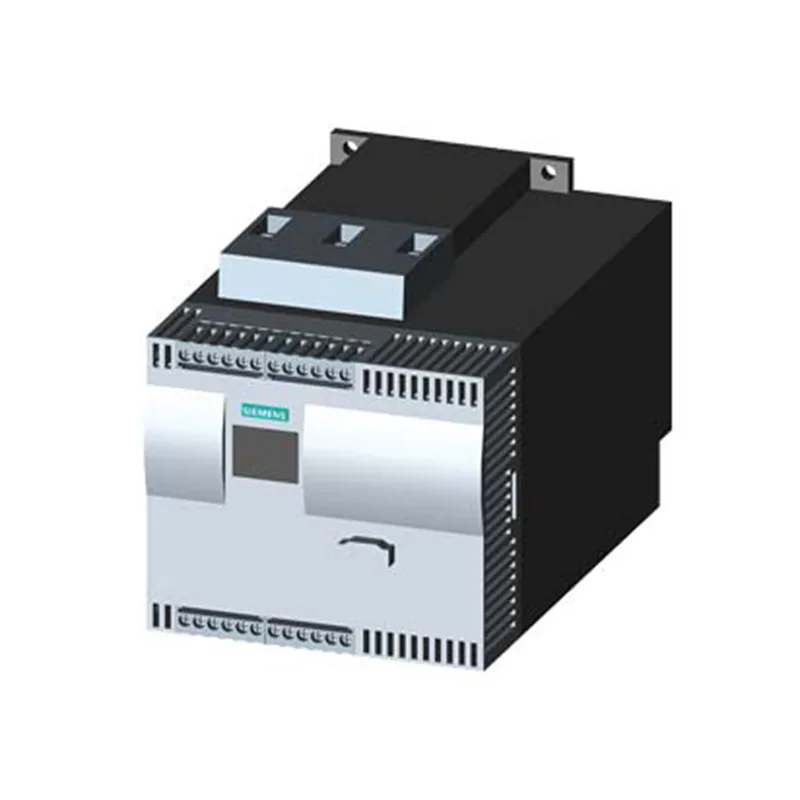
The Siemens 3RW4424-3BC34 is a SIRIUS soft starter, a thyristor-based motor starting device that ramps voltage to limit inrush current during start-up. It's rated 81 A at 40 °C, 73 A at 50 °C, and 64 A at 60 °C, with an insulation voltage of 690 V and operating frequency of 50/60 Hz. The 115 V control voltage is the same at both 50 and 60 Hz. An integrated bypass contact system means the thyristors are shorted out once the motor reaches full speed, eliminating heat dissipation from the semiconductors during run. That's a key difference from open-loop soft starters that keep the SCRs in circuit and need derating for continuous duty. It supports inside-delta circuit wiring, which lets you connect the soft starter in the motor's delta loop rather than line-side. That reduces the current rating required for the soft starter to about 58% of the motor FLA — useful for squeezing a larger motor onto a given frame size.
The 81 A rating at 40 °C is the headline number, but the derating curve matters: at 50 °C it's 73 A, at 60 °C it's 64 A. The derating temperature threshold is 40 °C, so above that you lose roughly 9 A per 10 °C rise. Minimum load is 8% of the rated current. That's low enough for most standard induction motors, but if you're starting a very small motor or a lightly loaded one, check the actual running current against that floor. Adjustable current limitation is built in, so you can set the start current anywhere from about 1.5x to 4x FLA depending on the load. Motor overload protection and intrinsic device protection (over-temperature, phase imbalance) are included — no separate overload relay needed for most installations. That's the standard for most control panels, not a special case.
Clearance requirements: 100 mm above, 75 mm below, and just 5 mm at the sides. That side clearance is tight — you can pack these on a panel backplate with minimal air gap, but the vertical clearance is non-negotiable for heat rise. Dimensions are 192 mm high, 170 mm wide, 270 mm deep. The depth includes the heat sink and terminals, so account for that when laying out the gland plate or enclosure depth. Main circuit connections use box terminals accepting stranded 2x (4 to 50 mm²) or solid 2x (0.25 to 1.5 mm²). Auxiliary and control circuit connections are spring-loaded terminals. That's a mix: power wiring gets a screw clamp, control wiring gets a push-in spring cage. Keep your ferrule kit handy for the control side. Maximum motor cable length is 500 m — enough for most installations, but if you're running long feeders from a remote MCC, check that against your cable capacitance and the soft starter's dv/dt rating.
For compliance documentation: the SIRIUS line typically carries CE, UL, CSA, and EAC markings, plus RoHS and REACH declarations. Specific certification numbers for this order code should be verified against the manufacturer's declaration of conformity, but the product class is broadly approved for industrial control panels worldwide.
What's on the front panel
A display for fault signals is included — shows error codes directly on the device, no need to wire up a separate HMI or PLC to read out the fault reason. External reset input is present, so you can wire a remote pushbutton to clear faults without opening the panel door. A motor brake output is built in — that's a relay output that energizes when the soft starter is in the 'stop' state, typically used to release a mechanical brake on the motor shaft. Saves an external interposing relay.