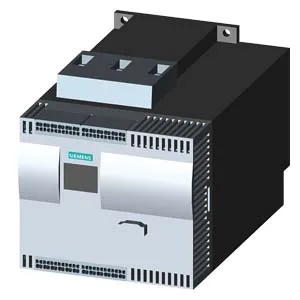
What the current ratings actually mean for the motor
The 3RW4427-3BC45: The 161 A at 40 °C is the continuous full-load current it can handle in a standard 40 °C enclosure — not a starting surge, but the steady-state current after the motor is up to speed. At 50 °C ambient, that ceiling drops to 142 A, and at 60 °C it's 125 A. If your panel runs hot, the soft starter derates itself; you size the overload protection to the derated number, not the 40 °C nameplate. The minimum load threshold is 8 % of the rated current — below that the thyristor firing angle can't regulate properly, and the motor may cog or the soft starter may trip on phase loss. Keep the connected load above that floor.
Integrated bypass — why it matters for heat and efficiency
This soft starter has an integrated bypass contact system. Once the motor reaches full speed, the thyristors are shunted out, and the current flows through the bypass contacts. That means the thyristors stop conducting and the heatsink stops accumulating heat — the soft starter runs cool in steady-state, and you don't need to oversize the panel ventilation for continuous thyristor dissipation. The bypass also reduces the electrical load on the thyristors during normal running, which extends their service life — a common failure point in soft starters that lack bypass.
Inside-delta wiring — when to use it
The unit supports inside-delta circuit wiring. In that configuration, the soft starter is wired between the motor windings rather than in the line supply, so the current through each thyristor is roughly 58 % of the line current. This lets the same 161 A unit handle a larger motor — useful when retrofitting into an existing motor with a higher FLA than the soft starter's line rating would otherwise allow. The trade-off is that the motor must have all six winding leads brought out to the panel.
Mounting and cooling clearances — don't choke the heatsink
The unit is screw-fixed to a vertical mounting surface. It's rotatable ±90° and tiltable ±22.5° front/back — so you can orient it to fit the panel layout, but the vertical-surface requirement is non-negotiable for natural convection cooling. Clearance above the unit must be 100 mm, below 75 mm, and at the sides just 5 mm. Stacking units without that top clearance will bake the upper unit's thyristors.
Terminal blocks — main power vs control wiring
The main current circuit uses box terminals accepting 10 AWG to 1/0 AWG (using both clamping points) or 10 to 2/0 AWG using a single clamping point. That covers most motor feeder sizes up to 161 A. The auxiliary and control circuit uses spring-loaded terminals for 24 to 16 AWG solid or stranded — no screw tightening needed on the control wiring, which speeds up commissioning and prevents loose-terminal faults on the 24 VDC control loop.
Protection functions built in — overload, current limit, device protection
Motor overload protection is integrated, so you don't need a separate overload relay downstream. The adjustable current limitation lets you set the starting current anywhere below the full rated current — useful for limiting inrush on weak supplies or soft-coupled loads. Intrinsic device protection monitors the thyristor junction temperature and the heatsink temperature; if the thermal budget is exceeded, the soft starter inhibits a start or reduces the current to protect itself.