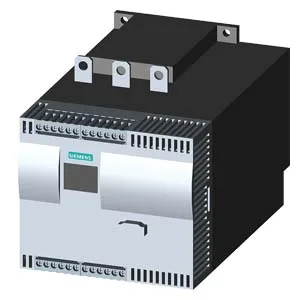
Rated current derating — the 40 °C baseline matters
The 3RW4435-2BC44: At 40 °C ambient the unit delivers 232 A continuous — this is the rating to use for BOM sizing in a ventilated panel. If the soft starter sits in a sealed enclosure or near other heat sources, apply the derating curve from the datasheet; the 40 °C figure is not the safe ceiling in a hot cabinet. The insulation voltage is rated 690 V, so the unit comfortably handles 400 V and 480 V line-to-line systems with margin. Operating frequency covers 50 to 60 Hz, making it a single SKU for global line voltages.
Panel integration — mounting and clearances
Mounting is by screw fixing with a vertical mounting surface that can be rotated ±90° or tilted ±22.5° front-to-back. This gives flexibility in panel layout — the unit does not demand a specific orientation beyond vertical. Clearance requirements: 100 mm above, 75 mm below, and 5 mm at the sides. The top clearance is the critical dimension for hot air exhaust and arc-flash containment; the 5 mm side gap is tight but sufficient for a standard panel layout. Dimensions are 200 mm high, 170 mm wide, and 270 mm deep — confirm the backpanel depth and door clearance before committing the cutout.
Wiring — main and control terminals
Main circuit wiring accepts stranded conductors from 25 to 120 mm², finely stranded from 16 to 95 mm², and kcmil 4 to 250. This covers both metric and AWG cable sizes commonly used in North American and European panels. The main current circuit also supports busbar connection, which is typical in distribution-style builds. Auxiliary control terminals accept solid wire 2x (0.25 to 1.5 mm²) or finely stranded 2x (24 to 16 AWG). The busbar clamping points allow up to 2x 1/0 on both sides, or 6 to 2/0 on the front or back clamping point. Maximum motor cable length is 500 m — sufficient for long feeder runs from the MCC to the motor, but verify the cable capacitance does not cause nuisance tripping on the thyristor firing circuit.
Protection and control features
Integrated motor overload protection and intrinsic device protection reduce the need for external overload relays and short-circuit coordination devices. The adjustable current limitation lets you set the starting torque profile — useful for soft-starting conveyors, pumps, and fans where the load inertia varies. The unit supports inside-delta circuit wiring, which reduces the line current drawn during starting by approximately 42% compared to standard in-line connection. This is a common topology for larger motors where the supply transformer has limited capacity. An external reset input allows remote clearing of faults from a PLC or control room pushbutton. The display shows fault codes on the unit itself, so a technician can read the trip cause without a laptop. Minimum load is 8% — below this threshold the thyristor firing may become erratic. If the connected motor draws less than 8% of the soft starter's rated current during start, consider a smaller frame or a bypass contactor.
Environmental and compliance
Pollution degree 3 per IEC 60947-4-2 — rated for industrial environments with conductive dust or occasional condensation. Storage temperature range is -25 to +80 °C; operation is permitted up to 60 °C ambient. The thyristor-based output stage (SCR) provides smooth voltage ramp starting without the mechanical wear of a contactor-based starter. The unit is part of the Siemens SIRIUS family, which shares a common accessory platform across contactors, overloads, and soft starters.