Active production — what that means for procurement
The 3RW4444-6BC45: No stock-holding claim is made here; the page exists to initiate that procurement conversation.
Current derating and ambient heat — the real operating envelope
Rated 433 A at 40 °C ambient — that is the reference point for sizing. For a steel-mill environment where cabinet ambient near the drives can hit 50–60 °C, the 320 A figure at 60 °C is the one to design to, not the 40 °C number. The derating temperature is specified at 40 °C, which means above that the unit must be downrated per the published curve. If your panel pulls radiant heat from adjacent rolls or furnaces, budget the 60 °C column — 320 A continuous is the safe ceiling.
Inside-delta wiring and minimum load — what it handles
Inside-delta circuit capability means the soft starter's thyristors are wired in the delta legs of the motor, not in the supply lines. This reduces the current through each thyristor branch to 58% of the line current — a common topology for high-current soft starters above 300 A where standard in-line thyristor stacks would be oversized. Minimum load is 8% — the soft starter needs at least that fraction of its rated current to maintain proper firing angle detection. Below 8%, the thyristor gate pulses may not latch reliably, so verify the motor no-load current against the 433 A rating before committing.
Mounting and panel fit — screw fixing with rotation allowance
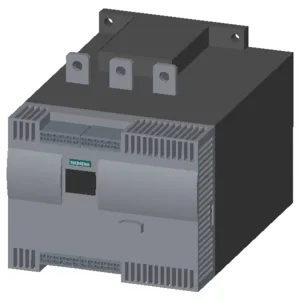
Fastening method is screw fixing, not DIN-rail snap-on. Dimensions: 230 mm height, 210 mm width, 298 mm depth. Clearance requirements: 100 mm above, 75 mm below, 5 mm at the sides. The 100 mm upward gap is for cable bending radius on the busbar connection — the main current circuit uses busbars, not cables, so the vertical clearance is driven by busbar standoffs, not wire loops.
Wiring terminations — main and control circuits
Main current circuit termination is busbar connection with stranded cable options 70…240 mm² and finely stranded 50…240 mm². For North American installations, the busbar clamping points accept 2/0…500 kcmil using both clamping points, or 250…500 kcmil using the back clamping point alone. The auxiliary contact terminals are sized for standard control wiring — no special crimp tooling needed beyond a standard ferrule kit. Maximum wire length from the soft starter to the motor is 500 m. Beyond that, voltage drop on the thyristor firing pulses and cable capacitance can cause misfiring — keep the run under 500 m, or add a line reactor at the soft starter output.
Protection and diagnostics — overload, current limit, fault display
Motor overload protection is integrated — no separate overload relay needed downstream. Adjustable current limitation lets you set the start current between 0 and the rated value, which is the primary parameter for tuning the acceleration ramp on high-inertia loads like conveyors or crushers. Intrinsic device protection monitors the thyristor junction temperature and triggers a fault if the thermal budget is exceeded — this is separate from motor overload. The fault signal is shown on a display with external reset capability, so a line-down fault can be cleared remotely without opening the panel door.