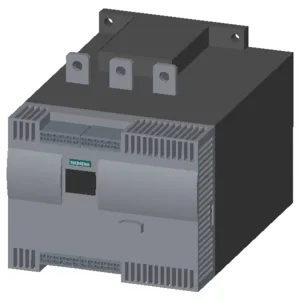
Rated current and thermal derating — what the numbers mean for a motor start
The 3RW4445-2BC34: For a panel sitting in a 50 °C environment — common in a packed MCC lineup — the usable continuous motor current drops to 485 A, so the motor FLA must stay under that ceiling, not the 40 °C figure. The minimum load threshold is 8 % of the rated current — below that the starter may not reliably detect the motor's running state. This matters for lightly loaded pumps or unloaded conveyors where the start current barely exceeds the no-load draw.
Inside-delta wiring and adjustable current limitation
This soft starter supports an inside-delta circuit configuration, which reduces the current through the thyristors to 58 % of the line current. For a 542 A motor, the thyristors see about 315 A, letting you use a smaller frame than a standard in-line connection would require. Adjustable current limitation lets you set the start current between the motor's no-load and locked-rotor values, so you can tune the ramp for a soft start on a conveyor or a hard start on a loaded crusher without swapping hardware.
Termination and mounting — what fits in the cabinet
Main power connections accept stranded 70–240 mm² or 2/0–500 kcmil copper, with a busbar connection option for the main current circuit. The front clamping point handles up to 600 kcmil; the back point takes 250–500 kcmil. For dual-cable runs, both clamping points together accept 2x 2/0 to 2x 500 kcmil. Auxiliary control wiring uses solid 0.25–1.5 mm² or stranded 24–16 AWG. The mounting position allows vertical surface mounting with ±90° rotation and ±22.5° tilt front-to-back — useful when the starter sits on a swing-out panel or a slanted enclosure backplate. Dimensions are 230 mm high, 210 mm wide, 298 mm deep. Clearance requirements: 100 mm above, 75 mm below, 5 mm at the sides. The 298 mm depth means the starter extends nearly 300 mm into the cabinet — check the enclosure depth before laying out the backplate.
Protection and environmental ratings
Built-in motor overload protection and intrinsic device protection (thyristor overtemperature, phase imbalance, load-wire break) are standard. The pollution degree is 3 per IEC 60947-4-2, meaning the unit tolerates conductive dust and condensation typical in industrial environments without conformal coating on the power board. Insulation voltage is rated 690 V, so the starter can run on 480 V or 600 V systems with margin. Operating frequency covers 50–60 Hz without a jumper change. Storage temperature range is -25 to +80 °C; operating ambient max is 60 °C. A display provides fault-signal readout — no need to carry a laptop to the panel for a blink code; the display shows the trip cause directly.