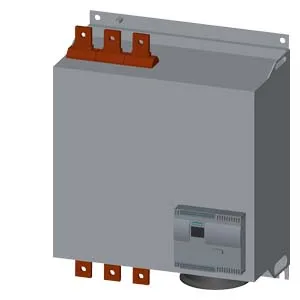
That 954 A figure is the full-load current it can handle in standard duty — sized for a motor pulling that current, not a peak surge. The 690 V insulation rating means it's fit for 400 V and 480 V systems with headroom, and it's rated for pollution degree 3 per IEC 60947-4-2, which is the industrial environment where conductive dust or condensation can occur — standard for motor control centers. The soft starter uses thyristors and includes an integrated bypass contact system, which means once the motor is up to speed, the bypass contactor closes and the thyristors are shunted out. That eliminates heat dissipation from the semiconductors during continuous run, so the enclosure doesn't need oversized ventilation for the running condition. It also provides motor overload protection and intrinsic device protection, so a separate overload relay is not required — the soft starter handles that function internally. The minimum load is 8% of the rated current, which means it can start lightly loaded motors or pumps without the thyristors failing to trigger — a common issue on soft starters when the load is too low for the firing circuit. Adjustable current limitation lets you set the start current between that minimum and the full rating, so you can tune the start profile to the load.
Inside-delta and wiring
This soft starter supports inside-delta circuit configuration, which is a wiring method where the soft starter sits inside the motor's delta connection rather than in the supply lines. That reduces the current through the thyristors to 58% of the line current, so a 954 A unit can effectively control a motor drawing more than 954 A line current — useful for squeezing a larger motor onto a given soft starter frame. The main current circuit uses busbar connection, not cable lugs, so the panel builder needs to plan for busbar drops rather than ring terminals. The main contact wiring accepts stranded 70 to 240 mm², finely stranded 50 to 240 mm², or AWG 2/0 to 500 kcmil. Auxiliary and control circuits use spring-loaded terminals accepting solid 2x (0.25 to 1.5 mm²) or AWG 24 to 16. The maximum wire length to the motor is 500 m — beyond that, voltage drop and reflected wave issues can affect the thyristor commutation. Mounting is by screw fixing on a vertical surface, rotatable ±90° and tiltable ±22.5° front-to-back. Clearance requirements: 100 mm upwards, 75 mm downwards, and only 5 mm at the sides — so it fits tightly between other devices in a lineup. The dimensions are 640 mm high, 510 mm wide, and 290 mm deep.
The operating frequency is 50 to 60 Hz, and the control supply voltage is 115 V at both 50 Hz and 60 Hz. The unit includes a display for fault signals, an external reset input, and a motor brake output component — so it can directly control a brake on the motor shaft without a separate contactor.