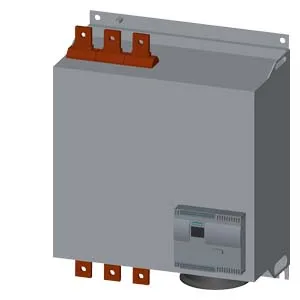
Rated current derating — the real thermal envelope for panel loading
The 3RW4454-2BC34: At 40 °C ambient the soft starter delivers 1,065 A continuous. That figure drops to 954 A at 50 °C and 847 A at 60 °C — a 20 % reduction from the 40 °C rating to the 60 °C ceiling. Panel builders should size the enclosure ventilation and busbar cross-section for the derated current at the expected internal ambient, not the headline 1,065 A number. The insulation voltage is rated 690 V, and the operating frequency covers 50 to 60 Hz, so the unit works on global line voltages without a hardware change.
Integrated bypass and inside-delta — two features that shrink the panel
An integrated bypass contact system eliminates the external bypass contactor normally required across the soft starter's thyristors. That saves one power contactor, the associated control wiring, and the heat dissipation from the bypass contactor coil. The thyristors themselves handle only the start/stop ramp; during run the bypass carries the full motor current with near-zero semiconductor losses. Inside-delta circuit capability reduces the current drawn from the line during start by approximately 42 % compared to an in-line connection, because each thyristor conducts only the phase-to-phase motor current rather than the full line current. This lets the soft starter handle a larger motor than its in-line rating would suggest — useful when the supply transformer or upstream breaker is the limiting factor.
Mounting, clearances, and termination — what fits in the enclosure
The unit measures 510 mm wide × 640 mm high × 290 mm deep and mounts with screw fixing. Clearance requirements: 100 mm above, 75 mm below, and only 5 mm at the sides. The tight side clearance means adjacent devices can be packed closely; the vertical gaps are for airflow through the heatsink and for cable bending radius. Main power connections use busbar termination — not cable lugs — so the panel design must include busbar runs rated for the full current. Stranded cable from 70 to 240 mm² and finely stranded from 50 to 240 mm² are accepted. The auxiliary and control circuit uses spring-loaded terminals accepting solid wire 2×(0.25-1.5 mm²) or AWG 24-16.
Motor protection and diagnostics — what's built in
Motor overload protection is integrated, so no separate overload relay is needed in the power circuit. The adjustable current limitation sets the starting torque profile to match the load — pump, conveyor, fan, or compressor. Minimum load is 8 %, which covers lightly loaded starts on unloaded conveyors or low-head pumps. A display shows fault signals for on-device diagnostics without an external HMI. External reset allows the fault to be cleared remotely from a PLC or pushbutton panel. The motor brake output controls a DC injection brake for applications that need a rapid stop — hoists, centrifuges, or indexing conveyors. The degree of pollution is rated 3 per IEC 60947-4-2, meaning the device is designed for industrial environments where conductive dust or occasional moisture condensation occurs. Operating temperature range is 60 °C max during operation, with storage from -25 to +80 °C. Maximum motor cable length is 500 m — beyond that, reflected wave voltage spikes may require an output reactor.