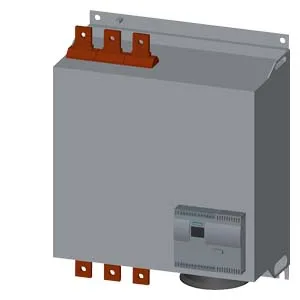
Rated current and thermal derating — sizing against the motor FLA
The 3RW4456-6BC36: The headline rating is 1351 A at 40 °C ambient. That is the continuous current the soft starter can carry in a 40 °C panel environment — match it to the motor full-load amps at the same ambient. Above 40 °C, the unit derates: 1200 A at 50 °C and 1065 A at 60 °C. If the panel ambient runs hotter than 40 °C, size up or provide forced ventilation to stay within the thermal envelope. The insulation voltage is rated 690 V, covering standard 400 V and 480 V line supplies with margin. Operating frequency is 50/60 Hz, so it works on either mains standard without derating.
Integrated bypass and inside-delta — wiring and panel space
An integrated bypass contact system means the soft starter's thyristors are shorted out once the motor reaches full speed. Inside-delta circuit capability allows the soft starter to be connected inside the delta winding of a delta-wound motor. This reduces the line current drawn by the starter to about 58% of the motor FLA — useful when the supply transformer or upstream breaker is marginal. The main circuit connection uses busbar; the auxiliary and control circuit uses screw-type terminals.
Mounting and enclosure fit
The unit measures 510 mm wide × 640 mm high × 290 mm deep. Clearance requirements: 100 mm above, 75 mm below, 5 mm at the sides. These are the minimum air gaps for cooling airflow; tighter spacing forces derating.
Protection and control features
Built-in motor overload protection and intrinsic device protection cover the thyristors and the motor — no separate overload relay is required in the BOM. Adjustable current limitation sets the starting current peak, typically between 1.5× and 4× FLA, to limit mechanical shock to the driven load. Minimum load is 8% — the starter can handle lightly loaded motors or soft-start applications where the load is decoupled at start. An external reset input and a display for fault signals are provided. Maximum motor cable length is 500 m — beyond that, capacitive charging current from the cable may interfere with the thyristor gate firing; keep runs shorter or add an output reactor.