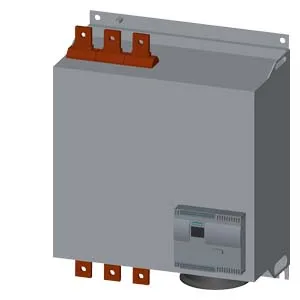
It uses thyristor-based current control and includes an integrated bypass contact system, so once the motor reaches full speed the bypass closes and the thyristors are shorted — that cuts heat dissipation in the enclosure and extends the life of the power stack. Rated operating frequency is 50 to 60 Hz, and it supports inside-delta wiring, which lets you size the soft starter for a lower phase current when the motor windings are configured in delta. That can save panel space and cost on larger motors.
Current rating drops from 1524 A at 40 °C to 1351 A at 50 °C and 1200 A at 60 °C. That 21% derating from 40 to 60 °C means if your enclosure ambient runs hot — say a packed MCC with other drives — you need to either oversize the soft starter or add forced ventilation. The 60 °C figure is the maximum during operation. Minimum load is 8% of the rated current, so it handles light-load starting like unloaded conveyors or centrifugal pumps without dropping out.
Mounting is screw fixing on a vertical surface, rotatable ±90° and tiltable ±22.5° front-to-back. That gives flexibility for tight panels — you can orient the busbar connections (main current circuit) to match your bus run. Clearances: 100 mm above, 75 mm below, 5 mm at the sides. Main circuit wiring accepts stranded 70–240 mm² or 2/0–500 kcmil. Auxiliary and control circuits use spring-loaded terminals accepting 2x (0.25–1.5 mm²) solid or 2x (24–16 AWG). Maximum motor cable length is 500 m — beyond that, capacitive charging current can interfere with the soft starter's firing circuit.
Protection and diagnostics
Built-in motor overload protection and intrinsic device protection are standard. Adjustable current limitation lets you set the start current between 8% and roughly 400% of the motor FLA (the 8% minimum applies to the load, not the limit range). An external reset input and a display for fault signals simplify troubleshooting on the line.