1864 A at 40 °C — the derating curve matters
The 3RW4465-2BC46: That 40 °C ceiling is the reference point — if your panel ambient runs warmer, the continuous current drops by roughly 10 % per 10 °C rise. Plan the cabinet cooling around the 60 °C figure if the enclosure sits near other heat sources. The integrated bypass contact system takes the thyristors out of the circuit once the motor is up to speed, so the heat load during run is just the bypass contactor resistance, not the SCR forward voltage drop. That keeps the internal temperature rise lower than a non-bypassed starter running the same current.
Cabinet footprint and wiring terminations
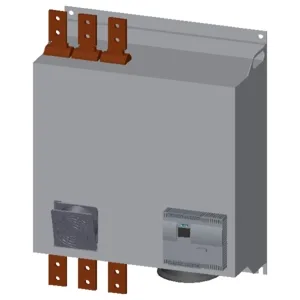
The unit measures 780 mm high by 575 mm wide by 292 mm deep — a substantial footprint that needs a floor-mount or large wall-mount enclosure. Screw fixing is the fastening method, so plan for drilled mounting points on a backplate or sub-panel. Power wiring lands on busbar connections with a stranded range of 70–240 mm² and a finely stranded range of 50–240 mm², plus a kcmil range of 2/0–500 for North American builds. Mounting position allows vertical surface orientation with ±90° rotation and ±22.5° tilt forward/backward, which covers most panel layouts. Clearance requirements: 100 mm upward, 75 mm downward, 5 mm at the sides — the side gap is tight, so airflow is primarily vertical.
Protection, control, and wiring flexibility
Motor overload protection and intrinsic device protection are both built in, with adjustable current limitation — you set the current limit threshold to match the motor FLA and the application's acceleration torque requirement. The minimum load is 8 % of the rated current, so it handles lightly loaded motors without nuisance tripping. An external reset input and a display for fault signals are standard — the display shows the fault code directly, so the commissioning engineer reads the trip reason without a separate HMI or software tool. A motor brake output is also included for applications that need DC injection braking. Maximum motor cable length is 500 m — sufficient for most industrial layouts, but if the motor is farther than that, add an output reactor to limit reflected wave voltage spikes.