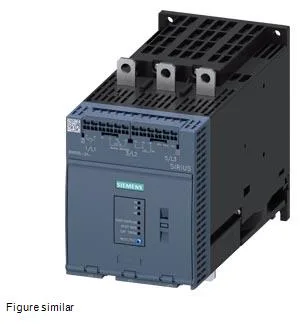
81 A minimum, ATEX-rated — the hazardous-area soft starter
The Siemens 3RW5056-2AB04 is a SIRIUS hybrid soft starter rated for a minimum motor current of 81 A at 200-480 V, with trip class 10A/10E (preset) or 20E per IEC 60947-4-2. The ATEX, UKEX, and IECEx certifications mean it can be wired into Zone 1 or Zone 2 motor circuits without an additional isolation barrier — the starter itself carries the explosion-protection marking. This is a hybrid switching device, meaning the starting path uses solid-state thyristors for the ramp, then a bypass contactor closes for run — no continuous heat sink load, so the panel fan load and enclosure size stay smaller than a pure solid-state starter of the same current class.
Trip class and starting profiles — matching the motor and load
The preset is 10A/10E, field-selectable via the HMI or parameter set. Three starting modes are built in: voltage ramp for gradual torque build-up, soft torque for loads that need a gentler initial breakaway, and pump ramp down for controlled deceleration that prevents water hammer in pumping stations. The analog output can be set to 4-20 mA or 0-10 V to feed a PLC or DCS with a real-time current signal during start. Minimum load is 15 % of the smallest settable Ie — so on a 100 A motor, the starter can still regulate down to 15 A loads without instability. The service factor is 1, meaning no continuous overload margin beyond nameplate; size the motor FLA at or below the starter's rated current.
Fieldbus and control — multi-protocol without a gateway
The 3RW5056-2AB04 ships with onboard PROFIBUS and PROFINET interfaces, plus Modbus RTU, Modbus TCP, and EtherNet/IP. No external communication module is needed for any of these — the starter appears as a standard IO device on the network. PROFIenergy is supported when used with the PROFINET standard communication module, allowing energy-management data collection during idle periods. Auto-reset is configurable for unattended restart after a fault clears. Remote reset is done by cycling the control supply voltage — useful for a DCS or PLC to clear a trip without a panel visit. The error logbook records the last fault events, but requires the special accessory module.
Panel fit and mounting — screw-fixed, not DIN-rail
The footprint is 120 mm wide × 198 mm tall × 249 mm deep. Clearance requirements: 100 mm above, 75 mm below, 10 mm forward, 0 mm backward, 5 mm at the sides. Plan the gland plate and busbar routing accordingly — the 249 mm depth means it protrudes further into the enclosure than a standard contactor. Shock resistance is 15 g for 11 ms — suitable for industrial environments with occasional vibration, but not continuous high-G applications like mobile equipment.