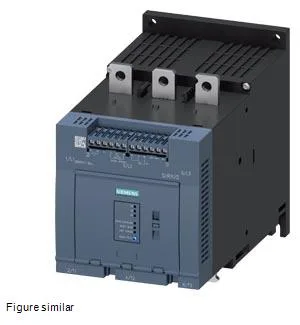
Trip class and motor protection — what the 10A/10E/20E means
The 3RW5072-6AB05 is preset to trip class 10E per IEC 60947-4-2, with selectable 10A or 20E. The minimum settable current is 90 A, which sets the floor for the motor FLC the unit can protect. Below that the overload curve won't calibrate correctly — pair it with a motor whose full-load current is at or above 90 A.
Voltage range and network fit
Rated voltage 200-600 V covers 208 V, 230 V, 400 V, 480 V, and 575 V systems without a transformer tap. That means one stock code serves both North American 480 V and European 400 V installations — useful for multinational panel builds or machines that ship globally. The control supply is 24 V DC — standard for PLC-driven panels. Remote reset is supported by cycling the control supply off and back on, so a PLC digital output can trigger a restart after a fault clears.
Fieldbus options — which network does it speak
This unit carries onboard Modbus RTU, Modbus TCP, EtherNet/IP, and PROFINET. PROFIBUS is also listed. That means it drops into most common industrial Ethernet or serial networks without an external gateway — one part number covers the plant-floor communication layer. PROFIenergy is supported when used with the PROFINET communication module — this allows the soft starter to be put into energy-saving standby during production pauses, coordinated by the controller.
ATEX and IECEx — hazardous area deployment
ATEX and IECEx certification (both marked Yes) means the 3RW5072-6AB05 is approved for installation in explosive atmospheres — typically Zone 2 or Zone 22 gas/dust areas. The certification covers the enclosure and internal arcs; the installer must still match the cable glands and conduit seals to the zone classification.
Mounting and thermal clearance
Screw fixing with a vertical mounting surface — the unit can be rotated ±90° or tilted ±22.5° front-to-back. Side clearance is 5 mm, upwards 100 mm, forwards 10 mm, downwards 75 mm, backwards 0 mm. That 100 mm upward gap is the critical one: hot air rises from the heatsink, and blocking it derates the output. Operating temperature range -25 to +60 °C, with derating above 40 °C. In a sealed enclosure with other heat sources, budget the internal ambient — if it hits 50 °C, the continuous current rating drops per the derating curve in the manual.
Application profiles — pump ramp down and soft torque
Pump ramp down and soft torque are both listed — these are the two features that matter most on centrifugal pump starts. Soft torque reduces the initial current spike on high-breakaway loads; pump ramp down extends the deceleration to prevent water hammer on valve closure. Voltage ramp is also available for basic starting profiles. Analog output is configurable 4-20 mA or 0-10 V — useful for feeding motor current to a PLC analog input or a panel meter without a separate transducer. The error logbook is available only with special accessories (not included).