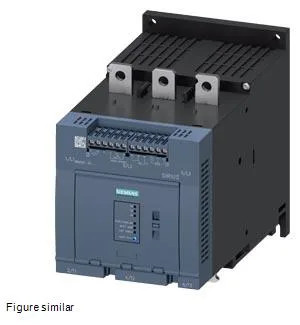
The Siemens 3RW5073-6TB05 is a SIRIUS 3RW5 soft starter rated for a minimum operating current of 100 A at a supply voltage range of 200 to 600 V AC. The 100 A floor means it is sized for motor full-load currents at or above that level; for smaller motors the minimum load is 15 % relative to the smallest settable Ie. Trip class is selectable among CLASS 10A, 10E (preset), and 20E per IEC 60947-4-2. Class 20E extends the ramp window to 20 seconds, useful for high-inertia loads such as centrifuges or large conveyors that need a longer acceleration without tripping the overload. ATEX and IECEx certification (both listed as Yes) means the device is approved for use in potentially explosive atmospheres. The unit carries UL, CSA, and CE marking as well, covering North American and European regulatory jurisdictions.
Communication and control integration
The 3RW5073-6TB05 supports PROFIBUS, Modbus RTU, Modbus TCP, EtherNet/IP, and PROFINET with PROFIenergy. This breadth means it can drop into a legacy PROFIBUS line, a modern EtherNet/IP plant, or a PROFINET-based system without an external gateway. The PROFIenergy profile allows coordinated energy management during pauses in production — the soft starter can be commanded into an energy-saving state by the controller. Remote reset is achieved by cycling the control supply voltage off and on — no separate reset signal wire needed. Automatic reset is also configurable, which is useful for unattended installations where a cleared fault should restart the motor without a manual visit. The unit includes soft torque, voltage ramp, and pump ramp down features. Pump ramp down gradually reduces voltage to the motor on stop, preventing pressure surges and water hammer in pumping systems. Soft torque reduces the initial torque peak during start, protecting driven machinery from mechanical shock.
Mounting is screw-fix only (not DIN-rail snap-on), with a vertical mounting surface that can be rotated ±90° or tilted ±22.5° front-to-back. The dimensions are 282 mm deep, 160 mm wide, and 230 mm high — a substantial footprint that requires panel layout planning. Clearance requirements: 100 mm upwards, 10 mm forwards, 0 mm backwards, 75 mm downwards, and 5 mm at the sides. The zero backward clearance means it can sit flush against a backplate. In a cold-storage or freezer application (common in industrial refrigeration), the -25 °C low end is sufficient for ambient conditions down to deep-freeze levels. The derating above 40 °C means the 100 A rating may need to be reduced if the panel ambient exceeds that threshold — typical for a non-ventilated enclosure near a process oven or compressor. Shock resistance is 15 g / 11 ms, dropping to 12 g / 11 ms if potential contact lifting is a concern. This is adequate for most industrial floor-mounted panels; for high-vibration applications (near a reciprocating compressor or hammer mill), additional vibration damping may be needed.