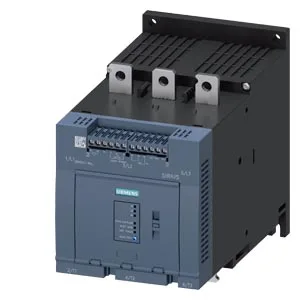
Hazardous-area motor starting with ATEX traceability
The 3RW5077-6AB04 carries ATEX, UKEX, and IECEx certification, making it suitable for soft-starting motors in Zone 1/2 gas or Zone 21/22 dust environments when installed per the system certificate. The 240 A minimum current rating defines the lower bound of the motor FLA it can protect — size up from this floor, not down. Operating range spans 200 to 480 V, covering 208 V, 230 V, 400 V, and 480 V networks common in industrial plants globally. The Trip Class is configurable as CLASS 10A, 10E (preset), or 20E per IEC 60947-4-2, which sets the maximum thermal memory during start — CLASS 10A limits heating for frequent starts, while CLASS 20E allows longer acceleration for high-inertia loads.
Fieldbus integration and commissioning constraints
This soft starter supports PROFIBUS, Modbus RTU, Modbus TCP, EtherNet/IP, and PROFINET simultaneously — no protocol adapter needed for multi-vendor control architectures. PROFIenergy is available when paired with the PROFINET communication module, enabling energy-proportional load shedding during idle periods. Screw fixing is the specified fastening method — no DIN-rail clip, so allocate tool access for M5 or equivalent hardware. Clearance requirements: 100 mm upward, 75 mm downward, 10 mm forward, 0 mm backward, 5 mm at the side. These are the minimum air gaps for heat dissipation and cable bending radius — violating them derates the 60 °C ambient ceiling.
Lifecycle status and global approvals
Shock resistance is 15 g / 11 ms, dropping to 12 g / 11 ms with potential contact lifting, which matters for shipboard or mobile equipment installations.
Application-specific starting modes
Voltage Ramp and Soft Torque are both available — Soft Torque reduces the initial torque spike for belt-driven loads or conveyors where mechanical shock must be limited. Pump Ramp Down provides a controlled deceleration to prevent water hammer in pump stations, extending the life of check valves and pipe supports. Analog output is configurable as 4-20 mA (default) or 0-10 V via the High Feature HMI parameterization. Remote reset is supported by cycling the control supply voltage, and auto-reset is available for unattended restart after a fault clears — both reduce service calls on remote installations. Minimum load is 15% of the smallest settable Ie, meaning the starter will not regulate below that threshold — motors drawing less than 15% of the current setting may not start reliably. The error logbook function requires special accessories and is not available in the base configuration.