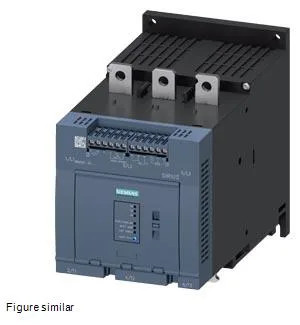
240 A minimum setting — the floor for motor FLA adjustment
The 3RW5077-6TB15 sets its minimum operating current at 240 A, meaning the smallest motor full-load amps you can configure this soft starter for is 240 A. That 240 A floor, combined with the 200-600 V operating range, covers common low-voltage motor ratings from around 110 kW at 400 V up to about 200 kW at 600 V, depending on the motor design and service factor. Trip Class is selectable between CLASS 10A, 10E (preset), and 20E per IEC 60947-4-2. ATEX and IECEx certification (both listed as Yes) means this soft starter can be installed in explosive-gas or dust atmospheres — Zones 1, 2, 21, 22 typically — as part of a certified motor-starting assembly. The ATEX rating applies to the device itself, not just the enclosure; check the specific gas group and temperature class for your area classification.
Fieldbus and control — what the network ports actually do
Onboard fieldbus includes PROFIBUS, Modbus RTU, Modbus TCP, and EtherNet/IP — all listed as Yes. That means you can drop this into a Siemens S7 environment over PROFIBUS or PROFINET (via the PROFINET communication module, which also enables PROFIenergy), or into a Rockwell/Allen-Bradley line over EtherNet/IP without a protocol gateway. The voltage ramp and pump ramp down features are both present — voltage ramp lets you tune the initial torque for soft starts on conveyors or compressors, while pump ramp down gradually reduces voltage to prevent water hammer on pump stop. Soft Torque is also available, which limits the current peak during the start phase for generators or weak grids. No analog output is fitted (Analog Output: No), so if you need a 4-20 mA signal for a remote meter or PLC analog input, you'll need the optional communication module or an external signal conditioner. The error logbook is available only with special accessories — not standard on the base unit.
Mounting and panel fit — clearances and fixing method
Clearance requirements are specified: 100 mm upwards, 10 mm forwards, 0 mm backwards, 75 mm downwards, and 5 mm at the sides. The zero backwards clearance means you can mount it flush against the back panel or a sub-panel — useful in tight enclosures. The 75 mm downward clearance is likely for power cable exit and should not be reduced. Mounting position allows vertical surface mounting with ±90° rotation and ±22.5° tilt forward/backward. That gives flexibility for angled sub-panels or sloped enclosures, but derating above 40 °C ambient (noted in the operating temperature spec) must be observed — at 50 °C expect a current derating of roughly 10-15% depending on mounting orientation.
Approvals and compliance — UL, CSA, CE, and hazardous-area certs
UL and CSA approvals are both listed as Yes — the unit carries a cULus mark suitable for North American panels. CE marking is Yes, covering the European Low Voltage and EMC directives. ATEX and IECEx certification are both Yes, as noted, which satisfies IEC 60079 requirements for Ex e (increased safety) or Ex d (flameproof) installations depending on the enclosure. Shock resistance is 15 g / 11 ms, with potential contact lifting noted at 12 g / 11 ms. That means the unit can withstand moderate shock events without nuisance tripping, but if your application involves repeated impacts above 12 g (e.g., on a crusher or press), you may need additional vibration damping or a different mounting scheme. Service factor is 1 — the soft starter is rated for continuous duty at its nominal current without overload margin. Do not oversize the motor protection based on a service factor above 1; the trip class settings handle the overload protection within the motor's thermal limits.