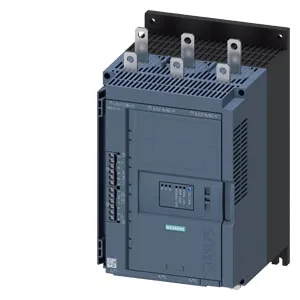
Trip class and motor protection under IEC 60947-4-2
The 3RW5136-1XC14 ships with a default trip class of 10A, but you can parameterize it to 10E or 20E per IEC 60947-4-2. That means during a stall or prolonged start, the soft starter lets the motor run up to 10 or 20 seconds before tripping — pick 10A for high-inertia loads that need a fast disconnect, 20E for conveyors that crawl up to speed. The minimum settable motor current is 81 A, and the minimum load is 15% of that value — so the soft starter can handle motors down to about 12 A without losing protection resolution.
Fieldbus and analog feedback — wiring once, reading from the PLC
This unit comes with PROFIBUS, Modbus RTU, and PROFINET on board — no separate communication module to slot in. If your line uses any of those fieldbuses, you can read status, fault codes, and current draw directly from the PLC without extra I/O. The analog output is configurable as 4…20 mA or 0…10 V, so you can feed motor current or load percentage to a local meter or a remote analog input. Default is 4…20 mA.
Mounting and clearance — panel layout constraints
Screw fixing to the back panel, dimensions 203 mm deep, 185 mm wide, 324 mm tall. Clearance requirements: 100 mm above, 75 mm below, 10 mm in front, 5 mm at the sides, and 0 mm behind the unit. That 0 mm rear clearance means you can mount it flush against the backplane — useful when panel depth is tight.
Operating temperature and derating
Ambient range during operation is -25 to +60 °C, but Siemens notes derating above 40 °C. If your panel sits near a hot process or in direct sun, you'll need to reduce the continuous current or add ventilation. Shock rated at 15 g for 11 ms, vibration 15 mm at 6 Hz and 2 g up to 500 Hz — solid for industrial environments with crushers or compressors nearby.