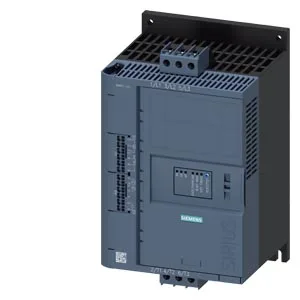
What this soft starter does on the line
The Siemens 3RW5213-3TC15 is a hybrid switching device — a soft starter for three-phase induction motors — that ramps voltage up at start and down at stop, reducing mechanical shock on the driven load and electrical stress on the supply. It's rated for a supply voltage of 200... 600 V and carries a minimum settable motor current of 5.5 A, so it's sized for smaller motors in the SIRIUS family. The Trip Class defaults to CLASS 10A per IEC 60947-4-2, which means it protects the motor against overload during start without nuisance tripping on normal acceleration — critical for keeping a conveyor or pump line moving at takt time. Communication is a strong suit here: onboard PROFIBUS, Modbus RTU, Modbus TCP, and EtherNet/IP are all listed, plus PROFINET standard and PROFIenergy support when paired with the PROFINET communication module. That means the starter integrates directly into a modern fieldbus architecture without an external gateway — one less failure point in the cabinet.
The Trip Class is configurable: CLASS 10A (default), 10E, or 20E per IEC 60947-4-2. A CLASS 10A trip allows the soft starter to pass motor start current for up to 10 seconds without tripping — enough for most standard-start centrifugal pumps and fans. CLASS 20E extends that window for high-inertia loads like crushers or centrifuges. The minimum load is 15 % relative to the smallest settable Ie, so you need to match the starter to the motor FLA within its adjustable range; running a motor well below that floor risks unreliable overload detection. The service factor is 1.
Mounting and clearances — panel integration
Mounting is screw fixing on a vertical surface. Clearance requirements are specific: 100 mm upwards, 75 mm downwards, 10 mm forwards, 5 mm at the sides, and 0 mm backwards. That backwards zero means the unit can sit flush against the back panel, saving depth in a shallow enclosure. The mounting position allows +/- 10° rotation and can be tilted forward or backward on the vertical surface — useful when aligning the gland plate entry. Wire terminations accept 2x (1.0... 2.5 mm²) and 2x (2.5... 10 mm²) solid conductors — the larger pair handles the power wiring, the smaller pair for control signals. Strip length and ferrule sizing follow standard Siemens practice; the spring-cage terminals hold reliably under vibration on a production line.