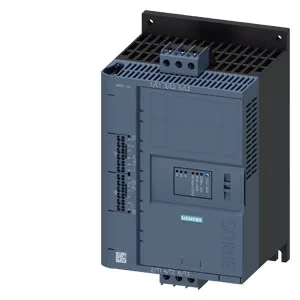
What the current range and trip class mean for your motor protection
The 3RW5215-3AC14 has a minimum adjustable current of 11.5 A, which sets the lower bound for the motor full-load current it can protect — if your motor draws less than that, the starter won't set correctly and nuisance tripping is likely. Class 10E and 20E are selectable for longer acceleration times or higher-inertia loads, per IEC 60947-4-2.
Fieldbus and control integration — what connects where
This soft starter supports PROFIBUS, Modbus RTU, Modbus TCP, EtherNet/IP, and PROFINET standard — so it drops into most common industrial networks without a gateway. An analog output is provided — 4...20 mA by default, or 0...10 V if parameterized with the High Feature HMI — for feeding motor current or other process signals back to a PLC.
Panel mounting and clearance — what the wireman needs to know
The unit measures 275 mm high by 170 mm wide by 152 mm deep, and requires the following free air space around it: 100 mm above, 10 mm in front, 0 mm behind (can sit flush to the backplane), 75 mm below, and 5 mm on each side — these are the minimum clearances for heat dissipation and wiring access. The solid wire terminals accept two conductors of 1.0...2.5 mm² and two of 2.5...10 mm², covering both control wiring and power connections in a single terminal block.
It carries CE, UL, and CSA approvals, so it is accepted in North American and European installations without additional certification work.