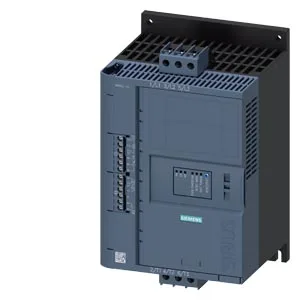
Motor starting envelope — voltage, current, trip class
The 3RW5217-1TC04: Rated supply voltage 200–480 VAC covers the common low-voltage motor bus in North America and Europe without a transformer tap. Also selectable CLASS 10E and 20E for higher-inertia loads like centrifuges or crushers where the start profile needs more time before the overload trip engages.
Fieldbus and control integration — five protocols on one unit
Native support for PROFIBUS, Modbus RTU, Modbus TCP, EtherNet/IP, and PROFINET standard means this single order code fits into any major control architecture without a separate gateway module. PROFINET variant also carries PROFIenergy for coordinated load shedding during production pauses. Remote reset cycles the control supply voltage (24 VDC) — no separate reset signal wire needed. Auto-reset is also configurable for unattended restart after a cleared fault, typical in pump or conveyor stations.
Panel fit — dimensions, clearance, mounting orientation
170 mm wide, 275 mm high, 152 mm deep — mounts via screw fixing to a vertical surface. Clearance requirements: 100 mm above, 75 mm below, 10 mm front, 5 mm sides, 0 mm rear. The zero rear clearance means the unit can sit flush against a back panel or enclosure wall without an air gap. Mounting position allows ±90° rotation and ±22.5° tilt forward/back from vertical — useful when the enclosure layout forces an angled or horizontal orientation. Shock rated 15 g / 11 ms, derated to 12 g if contact lifting is a concern.
Environmental and wiring limits
Operating ambient -25 to +60 °C with derating required above 40 °C — the heatsink sizing assumes free air convection; stacking or enclosed mounting above 40 °C needs the derating curve applied. Power terminals accept solid wire 2x (1.0–2.5 mm²) and 2x (2.5–10 mm²) — the larger cross-section handles the main motor feed, the smaller for control loop wiring.
Lifecycle and compliance — active production, global approvals
Listed as current production — no end-of-life notice or last-time-buy trigger. UL and CSA approvals cover North American panel builds; CE marking covers European machinery directive compliance.