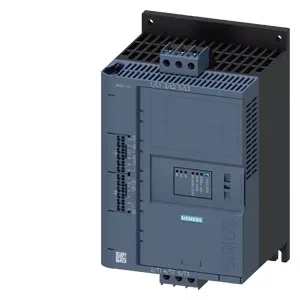
Trip class and motor protection — what the 10A/10E/20E rating means for your start profile
The 3RW5217-3TC04 ships with Trip Class 10A as default, with selectable 10E and 20E curves per IEC 60947-4-2. Class 10A clears the overload in 10 seconds at 7.2× FLA — tight enough to protect standard squirrel-cage rotors during a normal start, but if your load has high inertia (centrifuge, crusher, long conveyor), stepping to Class 20E buys you 20 seconds before the trip, which keeps the line running through a heavy start without nuisance tripping. The minimum load is 15% of the smallest settable Ie — below that the current sensing loses resolution and the overload protection may not trip reliably. If your motor FLA is under 15.5 A, this soft starter is oversized for the application.
Fieldbus and control integration — multi-protocol without a gateway
Native support for PROFIBUS, Modbus RTU, Modbus TCP, EtherNet/IP, and PROFINET means this soft starter talks directly to your PLC or SCADA without a protocol converter. The PROFINET variant also supports PROFIenergy for coordinated energy management during idle phases. The control supply is 24 V DC. Auto-reset and remote reset (by cycling the control supply) are built in — no extra wiring for a remote pushbutton if the operator station already has a 24 V control signal.
Panel mounting and clearance — fitting it into the enclosure
Clearance requirements: 100 mm above, 10 mm in front, 0 mm behind, 75 mm below, 5 mm at the sides. The 0 mm rear clearance means it can sit flush against the back panel, but the 100 mm above is non-negotiable for hot air exhaust — stacking another heat source above it will push the ambient past the derating threshold. In a sealed IP54 enclosure with other heat sources, budget for the temperature rise and size the cabinet ventilation accordingly.
Approvals: CE, UL, CSA — covers installations in Europe, North America, and Canada. The 3RW5217-3TC04 is a SIRIUS-branded device, part of Siemens' modular industrial controls family. It integrates directly with SIRIUS contactors and overload relays on the same DIN rail or screw-mounted panel.
Application-specific starting profiles — soft torque and pump ramp down
Soft torque mode reduces the initial current spike on high-inertia loads like conveyors or crushers. Pump ramp down extends the deceleration time to prevent water hammer in pumping systems — the operator can set the ramp-down time to match the pipe run length. Firmware is field-updatable, and an error logbook is available with the optional accessory. If the line faults at 2 a.m., the logbook captures the trip cause and current profile for later analysis.