What does Trip Class 10A mean for motor protection?
The 3RW5225-3TC14 defaults to Trip Class 10A per IEC 60947-4-2, which limits the starting current duration to 10 seconds at 600% of the motor FLA — that's the standard for most pump and fan starts. You can switch to 10E or 20E via parameter if the load needs a longer ramp, but the default keeps the motor thermal copy tight for general-duty induction motors. Minimum load is 15% of the smallest settable Ie — below that the soft starter may not detect the motor correctly, so don't try to soft-start a fractional-horsepower motor on this unit.
Panel fit and mounting — what clearance does it need?
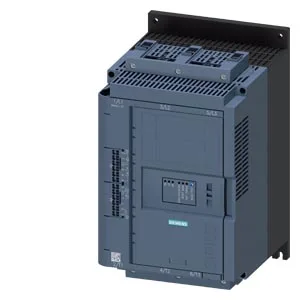
The unit measures 203 mm deep, 185 mm wide, 306 mm high — it's a substantial enclosure, so plan for that footprint on the backplate. Mounting is by screw fixing, and you can rotate it ±10° on a vertical surface if the cable entry demands it. Clearance requirements: 100 mm above, 10 mm in front, 0 mm behind, 75 mm below, 5 mm at the sides. The zero-clearance rear is handy for tight cabinets, but the 100 mm upward gap is non-negotiable for airflow — stack it tight and you'll derate earlier.
What fieldbus options come standard?
The 3RW5225-3TC14 ships with PROFIBUS, Modbus RTU, Modbus TCP, EtherNet/IP, and PROFINET support — no separate communication module needed for most networks. PROFINET with PROFIenergy is available via an optional standard module. That means you can drop this into a Siemens S7-1500 or Rockwell ControlLogix rack without a gateway — just set the IP and map the process data. The analog output is not present, so if you need a 4-20 mA speed signal, plan for a separate transducer.
Ambient derating and operating range
Rated for -25 to +60 °C during operation, but the spec explicitly notes derating at 40 °C or above — meaning if your panel hits 50 °C, you need to reduce the continuous current rating per the curve in the manual. Shock resistance is 15 g/11 ms, dropping to 12 g/11 ms if contacts might lift — fine for most industrial floors, but not for high-vibration crushers without additional damping.